
In June, Snowflake stood on stage and told its customers that the thing holding enterprise AI back was not the model. It was context. It shipped two products to prove the point. Microsoft shipped a business ontology. Redis shipped a memory platform. Pinecone shipped a compiler for enterprise data. Glean, which does nothing but make a company's own knowledge retrievable, reached roughly $300M in annual revenue, about triple where it sat fifteen months earlier.
IDC's Devin Pratt put it plainly: "the context layer, not the model, is the thing to watch right now."
Not one of those products was built for marketing.
They were built so that an analytics agent asked a question about revenue gives the same answer as the dashboard. That is a real problem and the infrastructure industry is spending billions on it. But it is a different problem from yours, and the difference is the reason your team cannot use any of it.
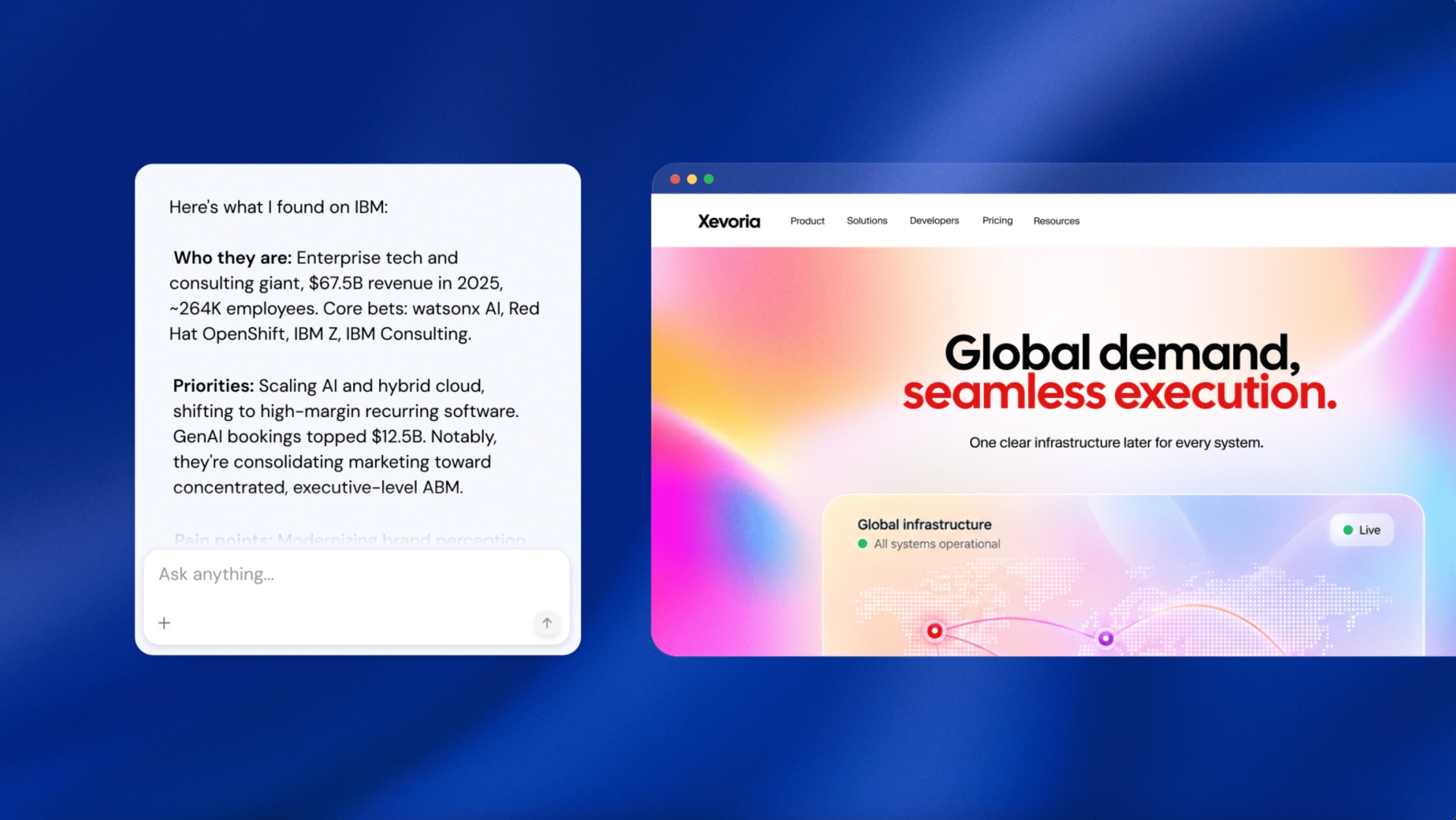
An analytics agent has to be correct. An enterprise ABM motion has to be relevant, approved, and aware of what was already sent. No semantic layer models a brand guideline. No catalog knows that legal retired a claim in March, or that this account already got the same case study twice.
The commoditization already happened
It is worth being precise about what got cheap, because it was not everything.
Account lists, firmographics, technographics, contact data and third-party intent all converged. Same sources, same providers under the hood, same refresh cycles. When every vendor's intent data flags the same account in the same week, the signal has become a timestamp.
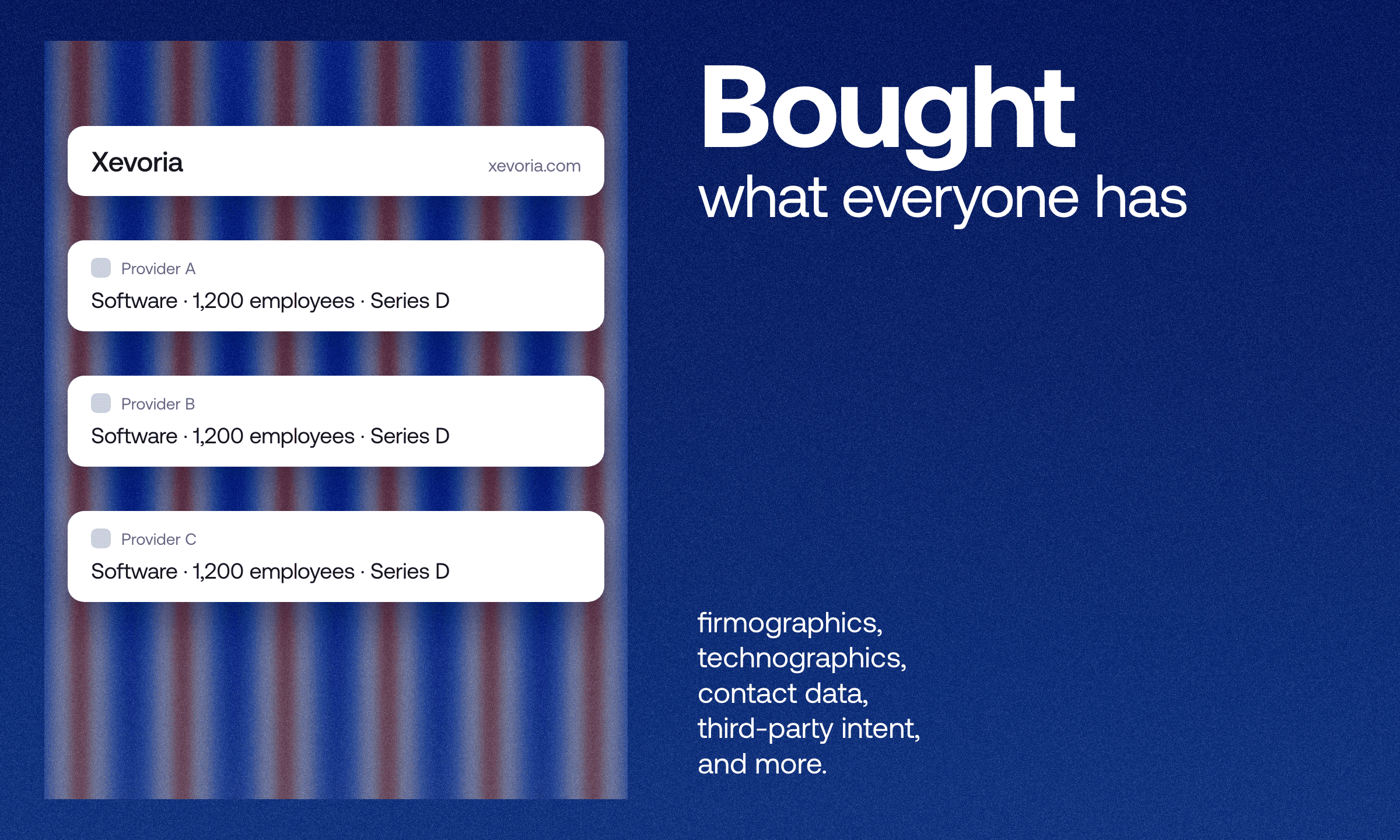
AI then did the same thing to production. Give a model a target and a prompt and it writes a page in seconds. That was the bottleneck for a decade, and it is gone.
Both of those were the hard parts, and both are now table stakes. The thing that did not get cheap is the thing that decides whether any of it lands.
Enterprise ABM teams are keeping context in GitHub
Here is the symptom that convinced me this is a layer and not a feature.
Some of the better marketing teams have started keeping their context in GitHub repos. Positioning, messaging, proof points, brand rules, versioned, in a repository, reviewed with pull requests.
No marketer wants to work in GitHub. They are there because every tool they were given models campaigns, assets and audiences, and none of them models what we believe and what we are allowed to say in a form that is current, versioned and callable by something else. So they reached past their own stack for the one tool that does.
That is not an engineering fashion. It is a category telling you what it is missing.
And it points at the thing most people get wrong about this: the context layer is not an engineering project. AI commoditized building. What it did not commoditize is having something clean and current to point the building at.
What is context, exactly?
"Context" has become a word people use without a referent. In an enterprise ABM system it means four specific things.
Your brand system. Not the logo file. How you are allowed to describe the product, which claims legal has cleared, which proof points are approved for which region, what you never say about a competitor. Most companies keep this in a PDF that three people have read, which is why it shows up as an approval queue. Every asset waits on someone who holds the rules in their head. Encode the rules and the queue becomes a check that runs at build time instead of a person who is on holiday.
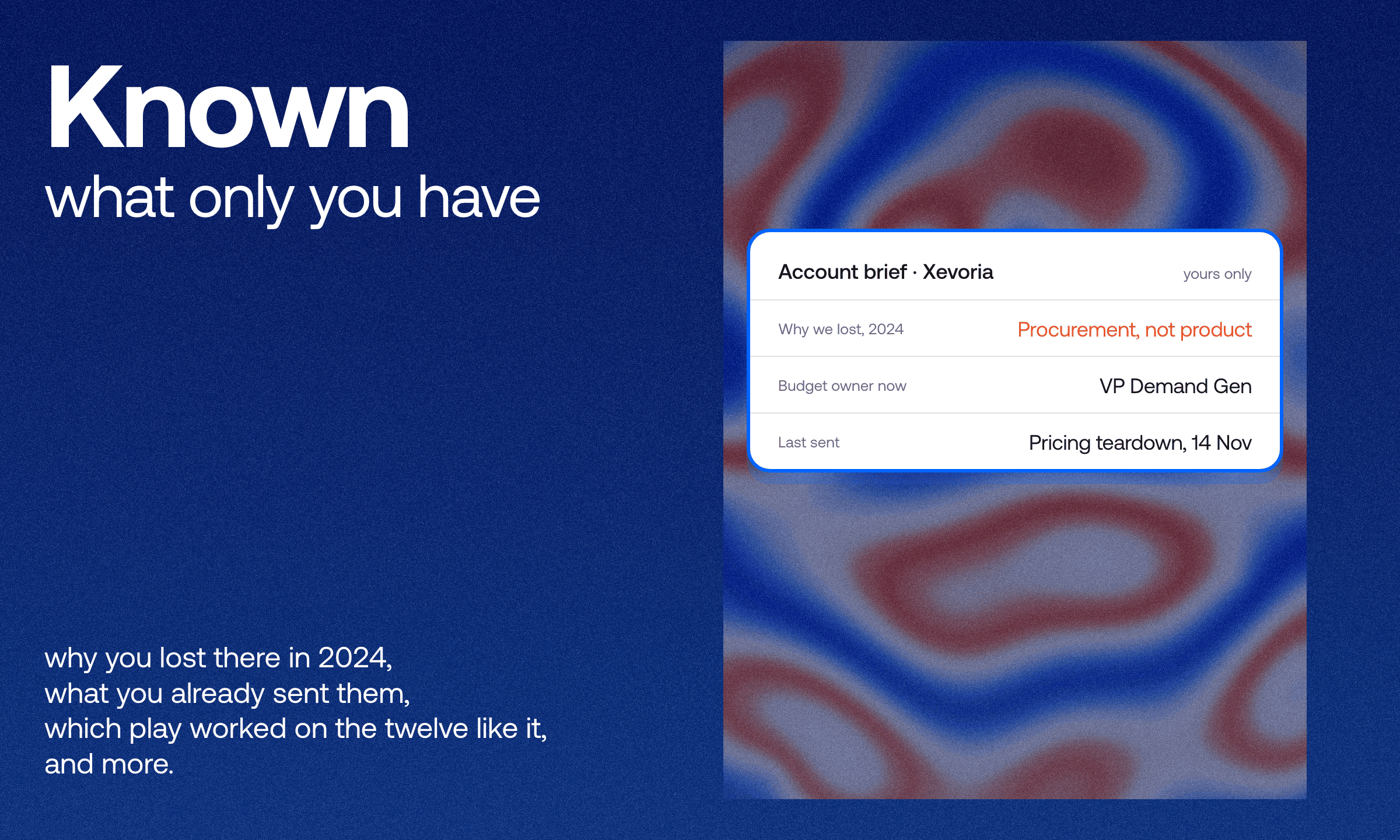
Your account intelligence. What you have learned about this account across every touch: the stakeholder map, the last three conversations, why you lost there in 2024, which integration they asked about twice.
Your market point of view. What you believe about the segment that your competitors do not. Not your category description, which everyone has. The specific claim: that mid-market fintechs fail at ABM because of compliance review and not budget, say, or that in this vertical the economic buyer is two levels below where the org chart suggests. That belief changes which accounts you pick, what the first line of the page says, and which objection you answer before it is raised. It cannot be bought at any price, and it is usually in a founder's head and nowhere else.
Your motion memory. What you already sent this account, what they opened, which play worked on the twelve accounts that look like this one.
Only the first looks like a document. The other three are live states that change weekly, and that is why keeping them as documents fails.
There is a word doing quiet work in all four: living.
A company's context is not a fixed thing you write down once. It changes when you add a product line, enter a region, restructure a team, or rebrand. Every one of those events invalidates part of what everyone knows, and none of them send a notification. The question is not whether your context is written down. It is whether, on the Tuesday after a rebrand, a field marketer in Singapore can pull the right version without asking anyone.
That is the bar. Not a document that was accurate when it was written. A layer that is accurate now, for whoever asks, wherever they are.
Why it has to be a system
Here is the test that separates a context layer from a folder of files.
Can it be called at every stage? Context that only exists at campaign build time cannot help the rep on the call next Tuesday.
Can it be called by every tool? If it lives in one platform, every other tool in the motion produces output that contradicts it.
Can it be called by both teams? Marketing's account understanding and sales' account understanding being different documents is the most expensive filing error in B2B.
Does using it make it better? This is the compounding one. A system where every campaign, reply and closed deal writes back is worth more each quarter. A folder is worth the same in December as it was in January.
Miss the last test and you do not have a context layer. You have a wiki, and wikis go stale in exactly the way that matters: silently, while still being technically present.
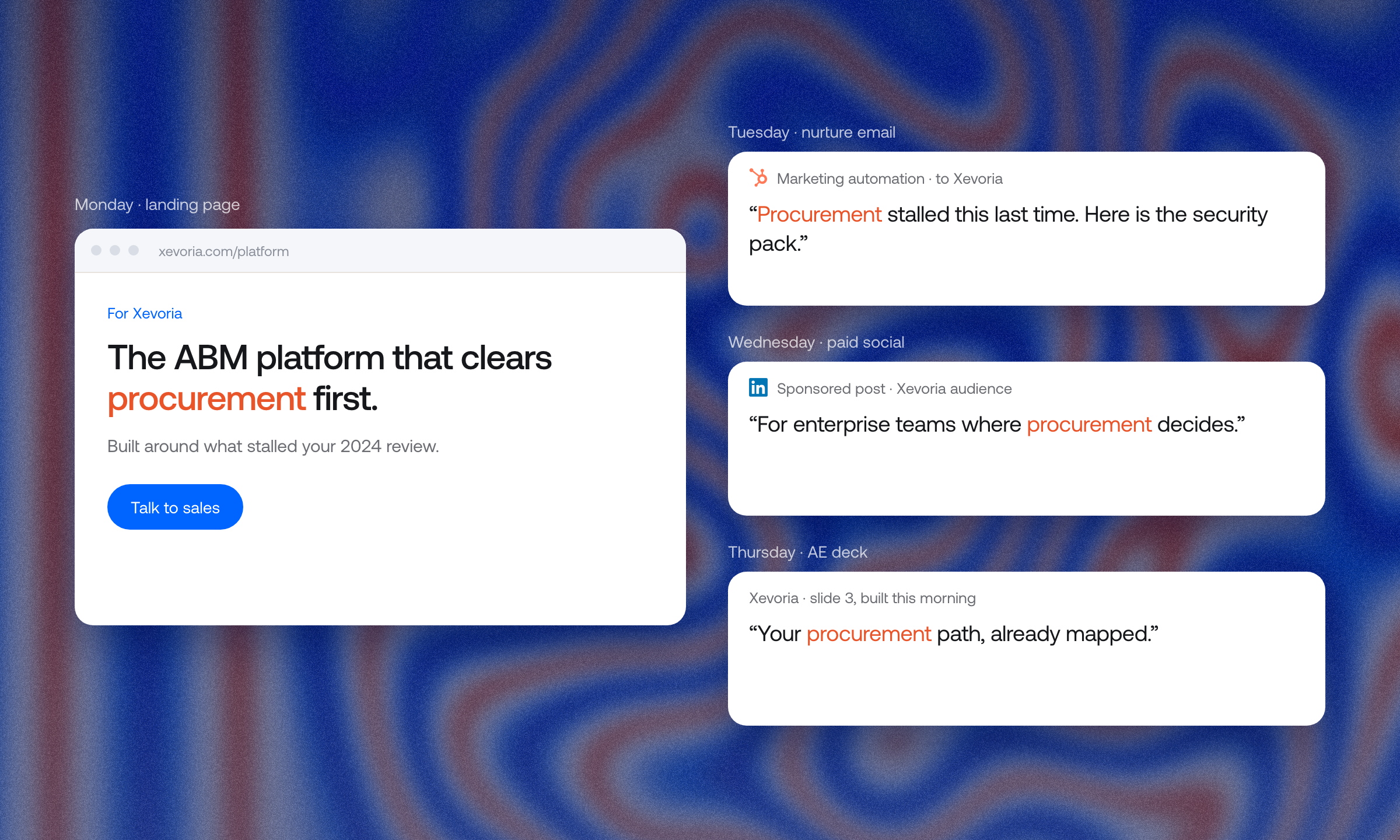
Here is what failing the first three looks like on one account in one week. They download the report on Tuesday. The nurture email calls them mid-market, because that is what the marketing automation segment says. The SDR's sequence quotes a case study from a different vertical, because that is the one in the shared folder. The AE's deck runs last quarter's positioning, because it was built last quarter. The landing page repeats a claim legal retired in March.
Four touches. One week. Four versions of who you are and who they are. Nobody did anything wrong, and no amount of better data fixes it, because the failure is not in what you know. It is that what you know is in five places and none of them can see each other.
The staleness is measurable
Our 2026 AI + ABM Trends Report, based on 250+ practitioners, found that 12% of teams automate account tiering. 21% still do it by hand, one account at a time.
A tier list refreshed quarterly is a statement about who mattered three months ago. Every downstream decision inherits that age – which accounts get the 1:1 treatment, which get a sequence, where the media budget goes. The model is not wrong. The input is old.
The same report puts a number on the "both teams" test. 29% run sales and marketing as separate motions. Another 31% are coordinated but have no automated process connecting them. Six teams in ten are keeping two versions of the same account in sync by meeting about it.
AI averages the internet. If what you feed it is what everyone else can also feed it, you will get back what everyone else gets back, faster. Speed to generic is not an advantage.
The strongest version of the counter-argument
The honest objection: this is a wiki with a new name. Every company has tried a single source of truth, and every one of those projects became a graveyard nobody updated. Why would this be different?
That objection has history on its side, and most context-layer projects will fail the same way, for the same reason. Humans do not maintain documentation that does not pay them back the same week.
What changes the economics is the writing path. A knowledge base maintained by hand decays, because updating it is a chore separated from the work. A context layer that updates as a by-product of running campaigns does not, because the maintenance is the work. Nobody writes the account summary. The account summary is what the system already knows, made available.
That distinction is the whole bet, and it is fair to hold a vendor to it. Ask what writes back, and when.
It is the right test. Mike Leone at Moor Insights put the warning bluntly: "Most vendors selling a drop-in fix are overpromising." He is right, and that is exactly the question to put to any vendor. Here is how Userled answers it, stated plainly.
Userled owns the brand system – typeface, logos, colors, target personas, product lines – and a knowledge hub where the team uploads its PMM material, so that every asset and campaign built on top is contextual, relevant and on brand. It knows what was sent to an account and when, because running the campaign is what records it. That is a context layer by the test above, and it is the half that touches activation.
It sits on top of your CRM and your warehouse rather than replacing them, so the context compounds where the work already happens. Your market point of view is the one piece no platform can supply. Write that down, and everything downstream of it is ours to run.
What this is worth when it works
Fingerprint went from 30 accounts to 300+, with audience penetration moving from 7.5% to 35% and $13M in influenced pipeline. Launch time went from one to two weeks down to under an hour.
Read the last number carefully, because it is the context number. You cannot compress launch to under an hour by typing faster. You get there when the system already knows the brand rules, the account, the segment position and what was sent last time – so the only new input is the decision.
Kpler went from 50 to 1,000 accounts in six months using the same mechanism. The limit on account coverage was never ambition. It was how much context a person could hold per account, multiplied by how many people you had.
The compounding test
Run this on your own stack. Pick an account you lost eighteen months ago and are now working again.
How long does it take someone to find out why you lost, who the buying group was then, what you sent, and what has changed at that company since?
If the answer is "ask Sarah, she was on it" – your context layer is a person, and it leaves when she does. If the answer is twenty minutes across four tools, it exists but cannot be called. If the answer is that it is already in the brief, you have one.
Most enterprise ABM teams are in the first two categories, and most of them are spending next year's budget on more data.
Your agency is your context layer
At enterprise scale the answer to that test is rarely a person inside the building. It is a partner.
Good agencies are genuinely good, and we work with several. This is not the argument that you should bring everything in house.
It is an argument about where the learning lands.
An agency that has run your programs for two years knows your positioning, your objection handling, which proof point works on which vertical, and what you sent this account last quarter. They have built a model of your market. It gets better every month. And it is theirs.
So ask what happens at the end. When the contract closes, or the account lead moves to another client, what stays behind? Usually a shared drive of finished assets. Finished assets are the output of context, not the context itself. You keep the pages. You lose the reasoning that produced them.
That is the structural problem, and it has nothing to do with the quality of the work. You are not renting execution. You are renting a context layer, and the agreement says it goes home at the end of the term.
Look at what that means for the number on your budget line. Part of that spend buys production, which is a fair thing to rent and getting cheaper every quarter. Part of it buys understanding of your own market, which is the one asset that should never have left the building. Most CMOs cannot say what the split is, and the split is the whole question.
The teams that figured this out did not fire their agency. They changed what they were buying. The brief stops being "run this campaign" and becomes "run this campaign, and everything you learn goes into our system, in our format, as part of the deliverable." Harder to negotiate. Occasionally more expensive. It is the difference between a partner who makes your programs better and a partner who makes themselves indispensable, and those two things look identical for about eighteen months.
Where to start with enterprise ABM in 2027
Not with a platform, and not with the build-versus-buy debate either, which we have covered one layer at a time. Start by writing down which of the four assets you actually have in a form something other than a human can read. For most teams it is one, sometimes two.
Then pick the one that is costing you most. For teams with long cycles and returning deals, it is account intelligence. For teams scaling past a hundred accounts, it is brand system, because that is the constraint that turns into an approval queue.
Userled sits on top of the CRM, data and signal tools you already run, and turns what they hold into the context every play is built from, with your team setting the rules and staying in control of what ships. We do not sell you data. You already have more than you use.
One last thing, aimed at whoever owns the budget.
The infrastructure industry has already decided this is the problem worth solving. Snowflake, Microsoft, Redis, Pinecone and Glean are not hedging about it. Every one of them is building the layer that sits between what a company knows and what its agents do with it, and every one of them is building it for someone other than you.
Your marketing team will get a context layer either way. The only question is whether you specify it, or whether you find out in two years that it was a shared drive, four disagreeing tools, and one person who knows where everything is.
If this is the year you fund it, the first move is not a purchase. Send this to the three people on your team who would have to maintain it, and ask them which of the four assets they could produce today, current, without asking anyone.
The answer to that question is your context layer. Everything else is a plan to build one.
Ready to win more deals? Talk to sales.
Generated £1.3M pipeline by focusing on UTM parameters personalisation.


Generated £1.3M pipeline by focusing on UTM parameters personalisation.