
This article was originally published on LinkedIn. (see here)
Most B2B companies know this. Very few act on it.
We talk about customer advocacy like it's a strategy. We list it in our OKRs. We nod in every all-hands when someone mentions "letting customers speak for us."
And then we go back to spending budget on ads and outbound sequences that get ignored.
We've been guilty of this too. Until we ran a campaign that changed how We think about ecosystem-led growth entirely.
This is the full behind-the-scenes – what we built, how we built it, what worked, what didn't, and where we're taking it next.
TL;DR
- 45-day campaign, 30 customer champions (organic opt-ins), gamified leaderboard built on V0 with participant profiles visible to each other
- Recruited via community Slack (200+ members) + personalized in-app video via Clip
- Notion playbooks for every action, dedicated Slack channel, weekly check-ins, mid-campaign threshold boost ($100 → $150 at 350 points) to re-ignite stalled participants
- Setup took a few days; ongoing management was ~2 hours/week
- Direct outputs: G2 High Performer (x2 categories), #2 usability & results, wave of customer LinkedIn posts reaching ICP
- Downstream outcomes: 3–4x meetings booked vs. 10/week baseline, $500K–$1M pipeline
- Total reward budget: ~$5–6K → ~100x return on reward spend
- Key insight: champions fall into two buckets – social amplifiers (operators, bottom-up reach) vs. pipeline drivers (directors/VPs, targeted senior network). Seniority + company stage are your best pre-campaign signals
- Next: 30-day campaigns every 4 months, split by champion type, growing incentives, customer advisory board, and a dedicated Social & Community Lead
First, the campaign at a glance
Before we get into the details, here's the setup so the rest makes sense.
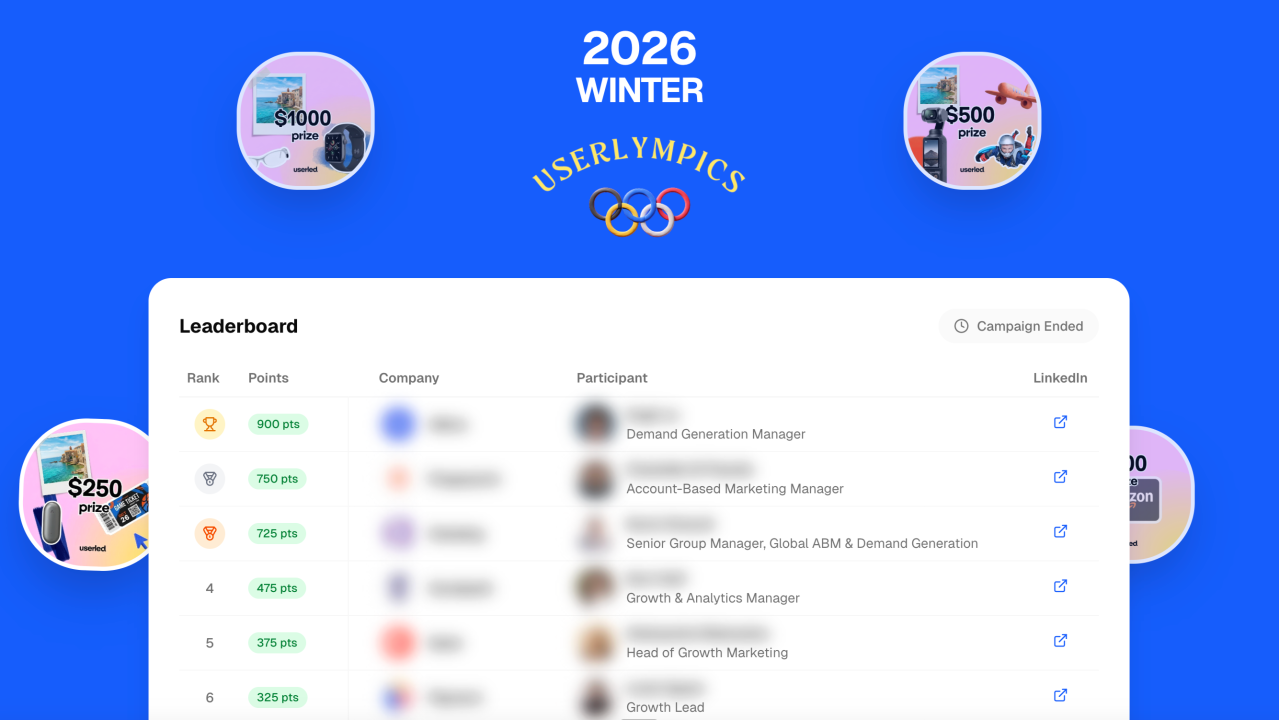
Name: The “2026 Winter Userlympics”. Seasonal campaigns ran in parallel with other renowned competitions (e.g., the 2026 Winter Olympics) makes them more fun and engaging.
Duration: 45 days (February – March 20th, 2026)
Participants: 30 customer champions
Objective: Turn our best customers into the voice of Userled – generating brand awareness, social proof, and pipeline through their networks and credibility, not ours.
How it worked: Each champion could earn points by completing a set of defined actions:
- Submitting a G2 review
- Submitting a Gartner review
- Contributing to a trend survey report
- Publishing a LinkedIn post about Userled
- Making a qualified intro with the team
Every action earned points. Points built a ranking. And that ranking determined what each champion walked away with at the end:
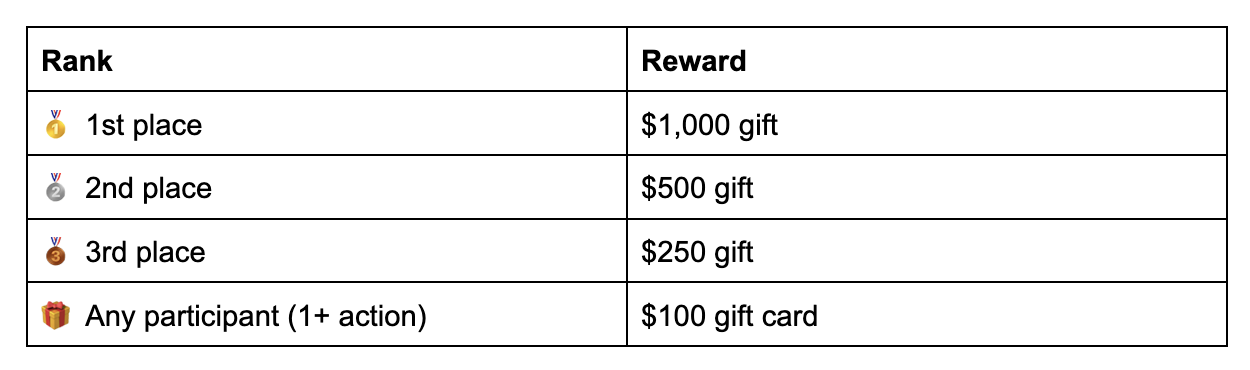
The $100 gift card for any single contribution was a deliberate design choice. It lowered the floor – you didn't have to compete to win something – and ensured even the least active participant had a concrete reason to do at least one thing.
The context: why now, why this
By the end of 2025, Userled had real momentum. We'd closed the year strong, bringing in known, fast-growing customers like ZoomInfo, Ramp, and Synthesia.
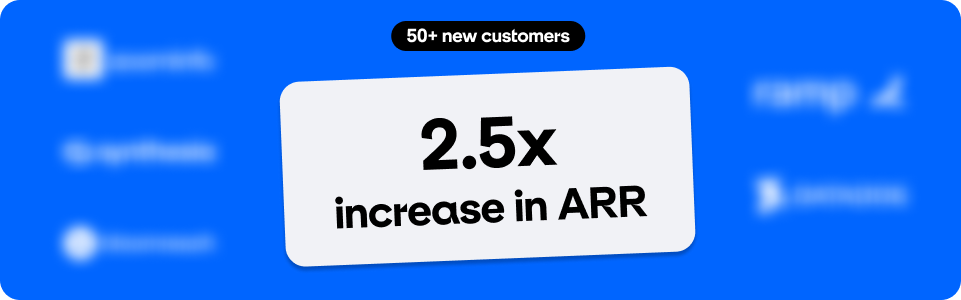
With that came a question we kept coming back to: we have incredible customers. Why are we still the ones doing all the talking?
So we got our customers to talk for us.
How we recruited 30 champions
Ecosystem-led growth is one of our core bets for 2026, but getting 30 customers to give their time and reputation to a 45-day campaign isn't a given. Here's exactly how we did it.
Channel 1: Our Userled community Slack. First, we announced the campaign concept, rules, and rewards in our channel of 250+ customers and members. People were genuinely excited.
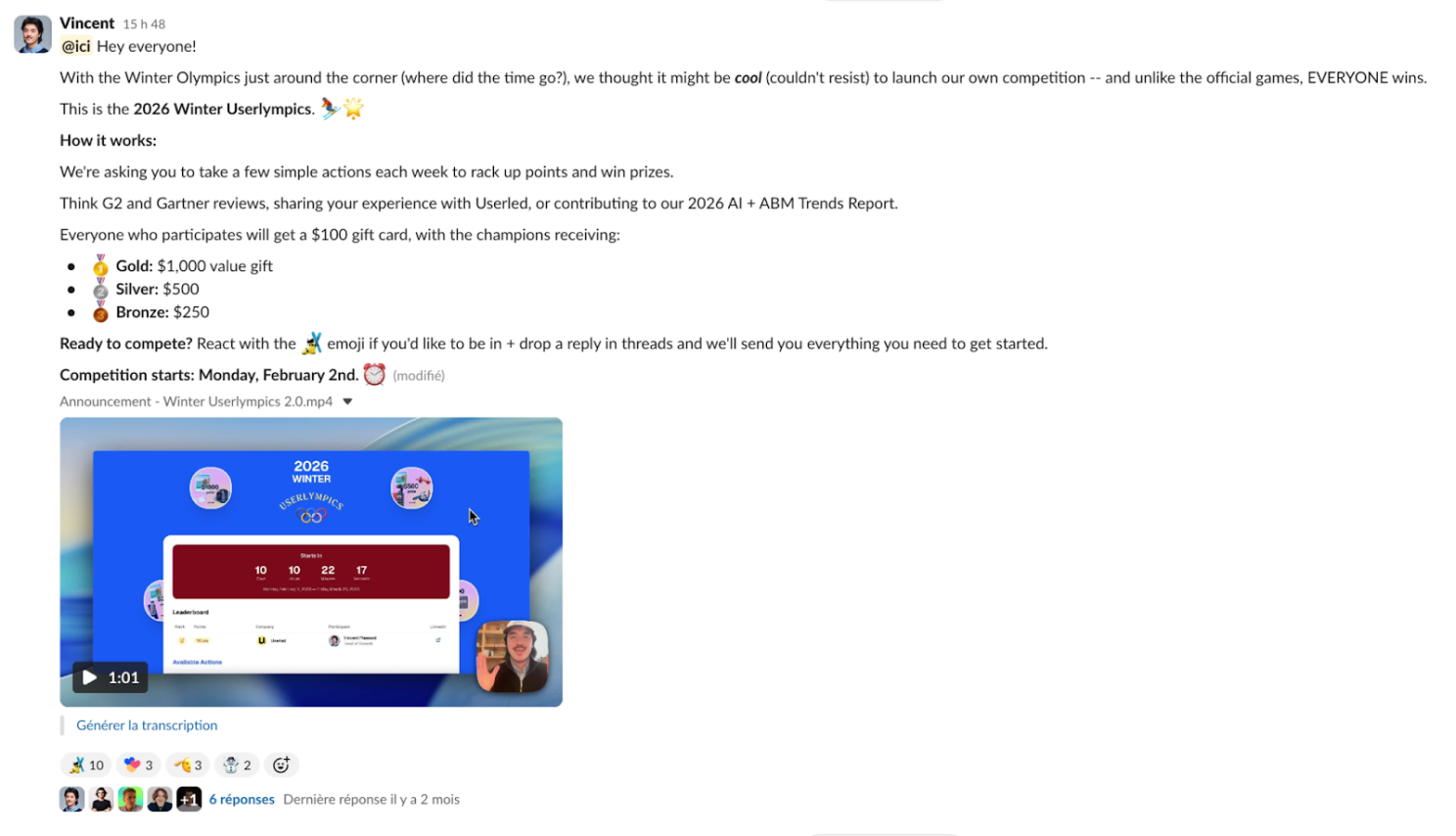
Channel 2: In-app, with a personal touch. We used Gleap – the tool we use for in-app communication and support – to reach users directly inside the platform. We sent an in-app pop-up paired with a personalized video explaining the campaign.
That combination is what got us to 30 participants.
This wasn't a curated list. These were customers who saw the message and replied with yes. Some were too busy, others weren't interested. The opt-in nature was intentional: you want people who are genuinely excited to participate.
Next time, we want to improve the conversion rate (30/250).
Better messaging. More touchpoints. Clearer value articulation.
I'll bring in more participants without sacrificing engagement quality. I'll also add two separate streams: one for operators and one for leadership, as the value their actions bring aren't comparable.
Building the infrastructure
If I was going to ask customers to commit their time, we needed to give them a real experience in return. So we built three things before the campaign launched.
- The leaderboard
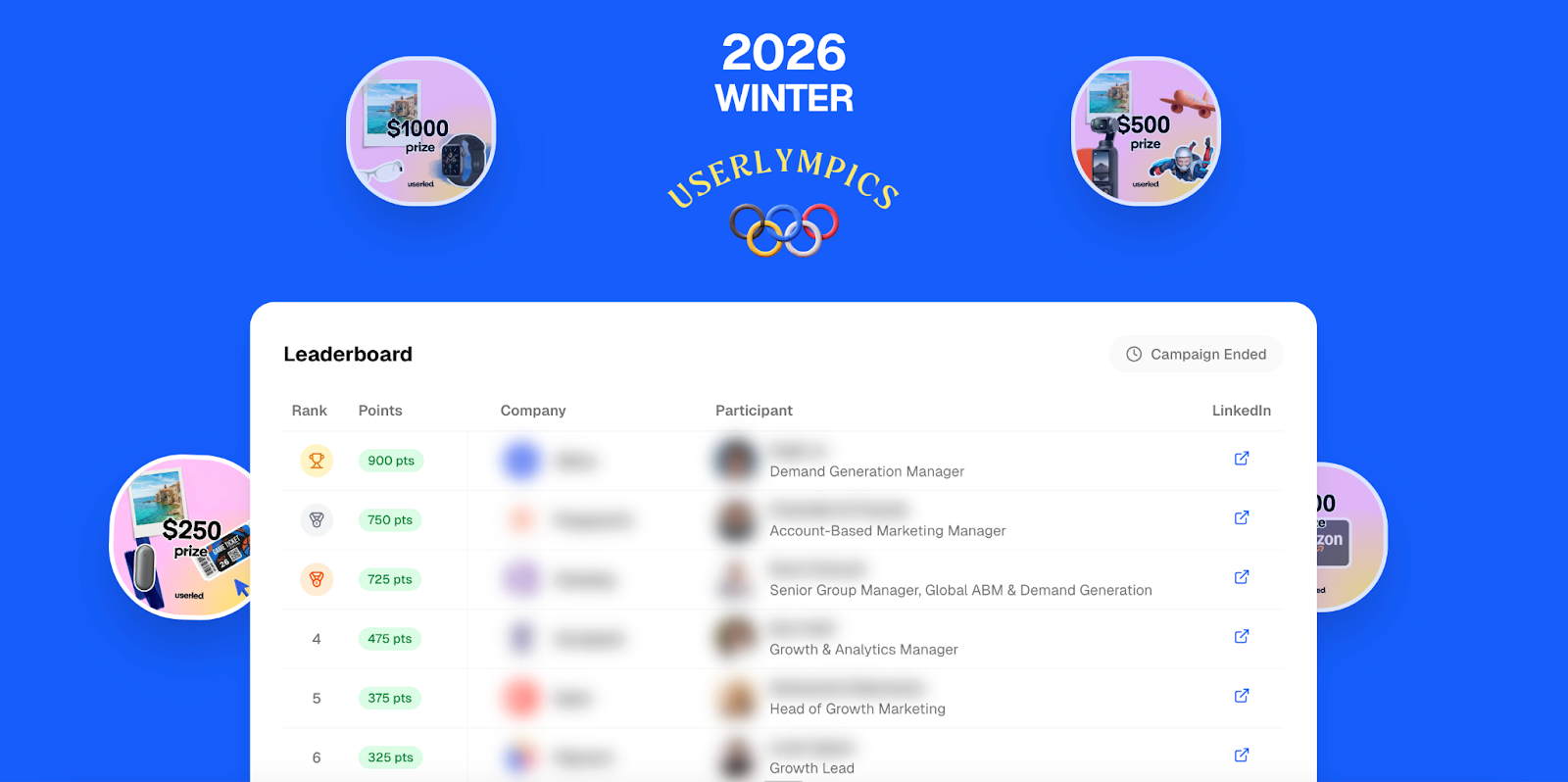
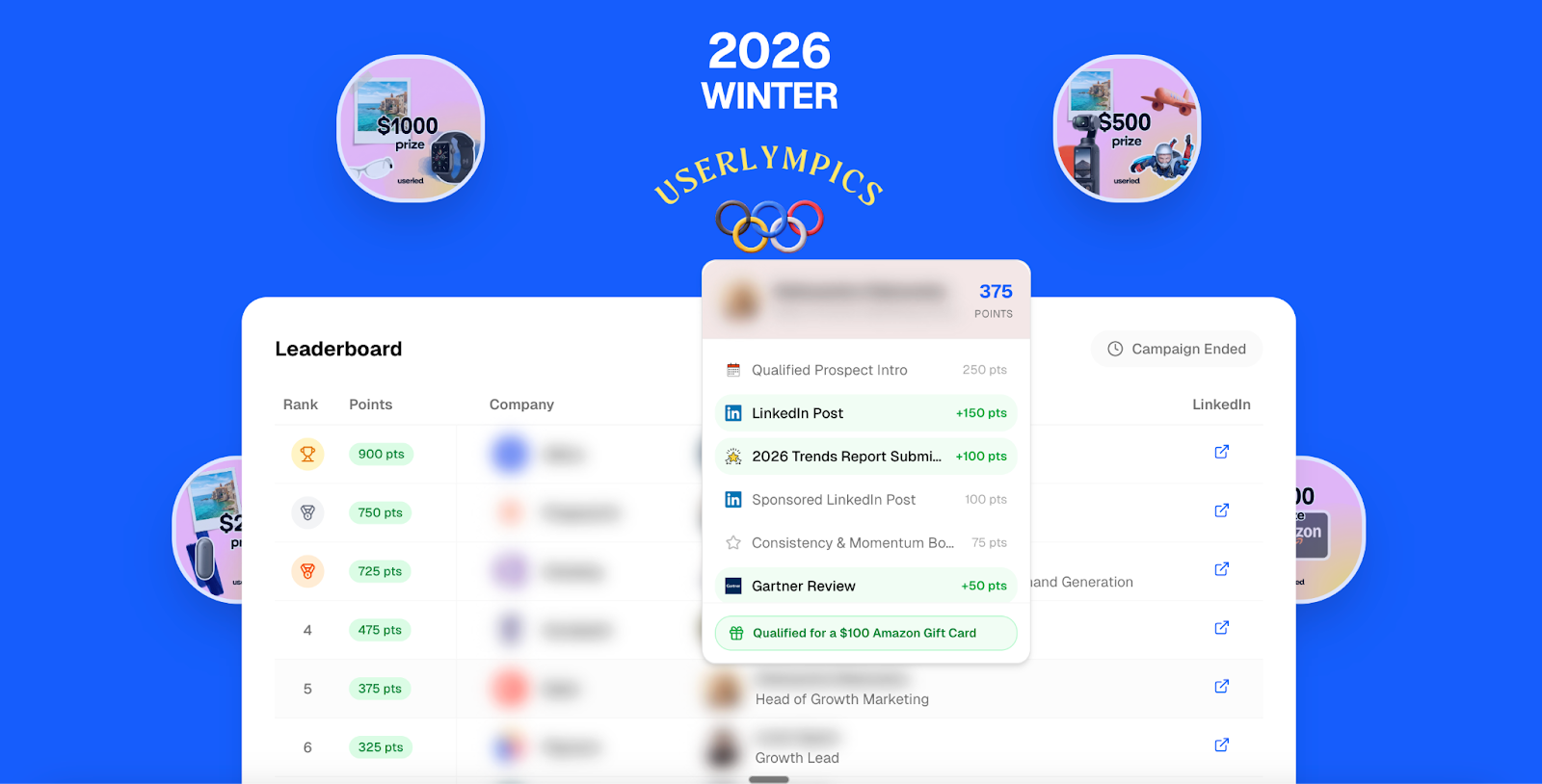
We used V0 to build a custom, real-time leaderboard.
Every participant could see:
- Their current rank
- Their total points
- Which actions they'd completed
- Which actions they still had available
- Participant details (name, company, and LinkedIn profile)
And because champions could see who else was participating, it created a sense of community, built trust, and enabled everyone to connect with each other.
It felt less like a vendor program and more like a small exclusive group of peers.
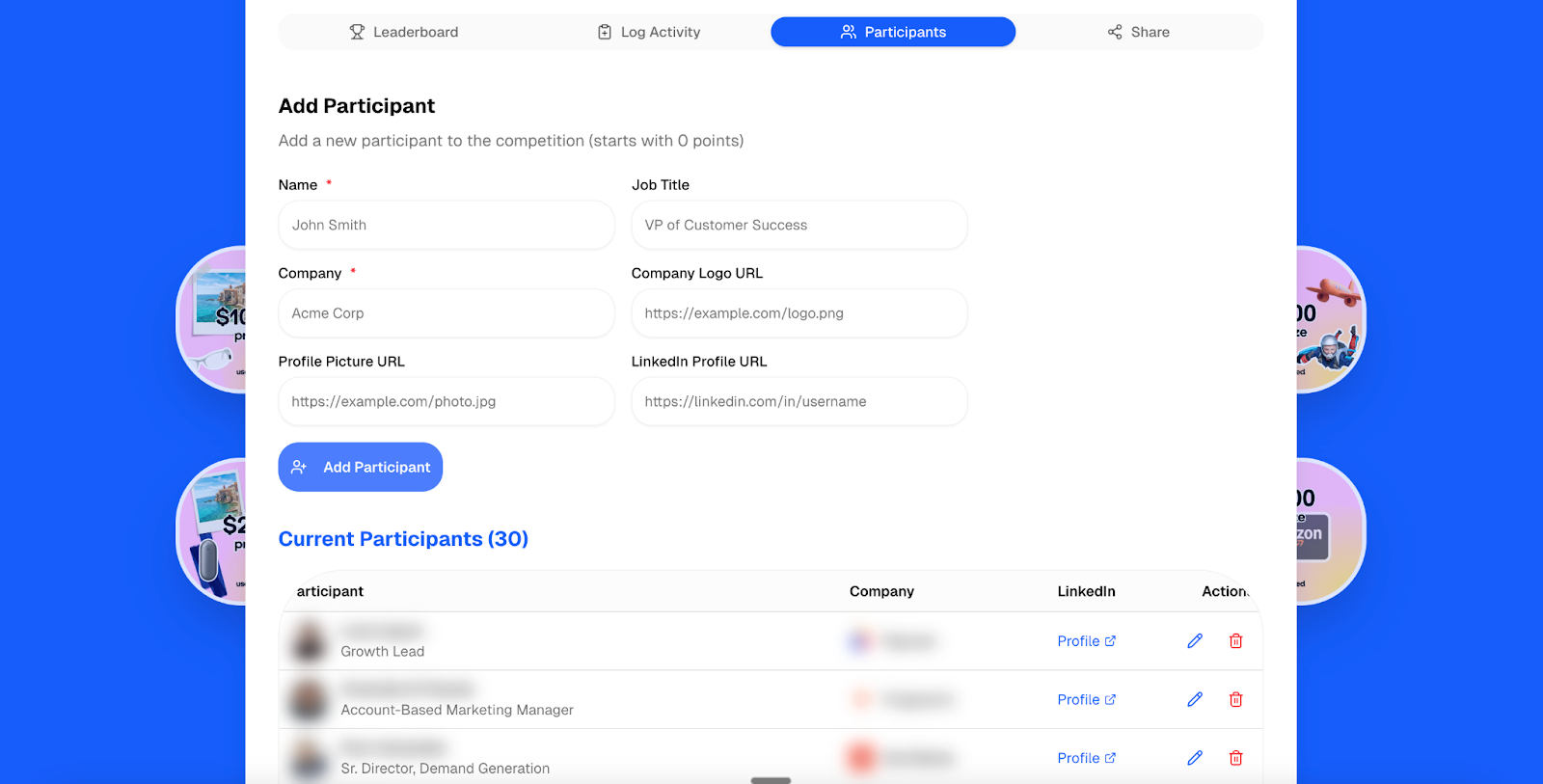
I had an admin panel to add participants, log their actions, and update scores in real time. No fancy automation – just me staying on top of it daily.
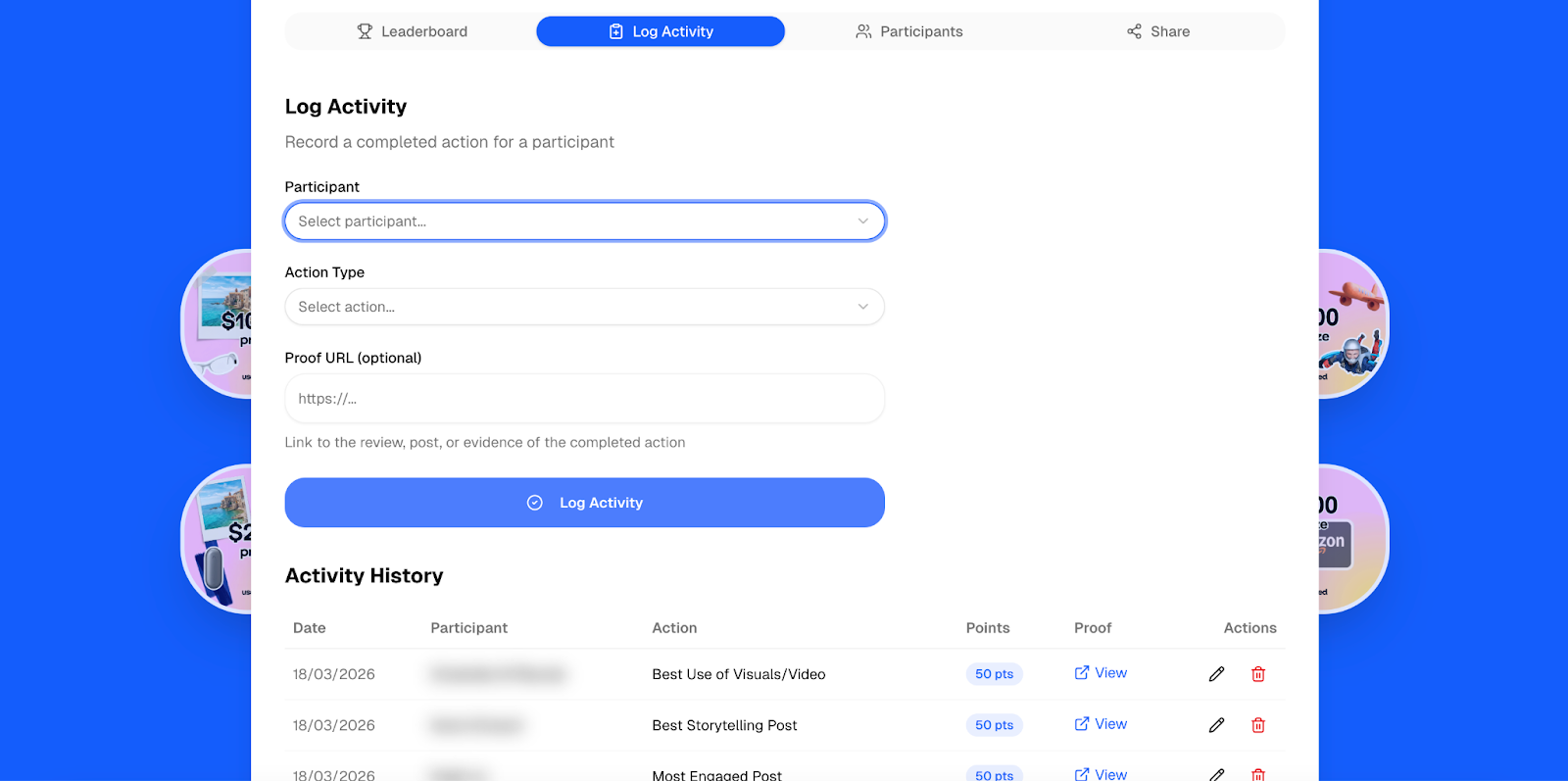
The leaderboard did something we underestimated: it made the campaign feel real. When someone saw their name move up or down the ranking, they cared. That competitive element was pulling people forward without me having to push. Every Friday, or when we were losing a bit of momentum, we used it to keep participants engaged and share actions that could help them move up in the leaderboard.
- The Notion playbook
We created a dedicated notion page with tutorials for each action participants could take, making it easy for them to contribute.
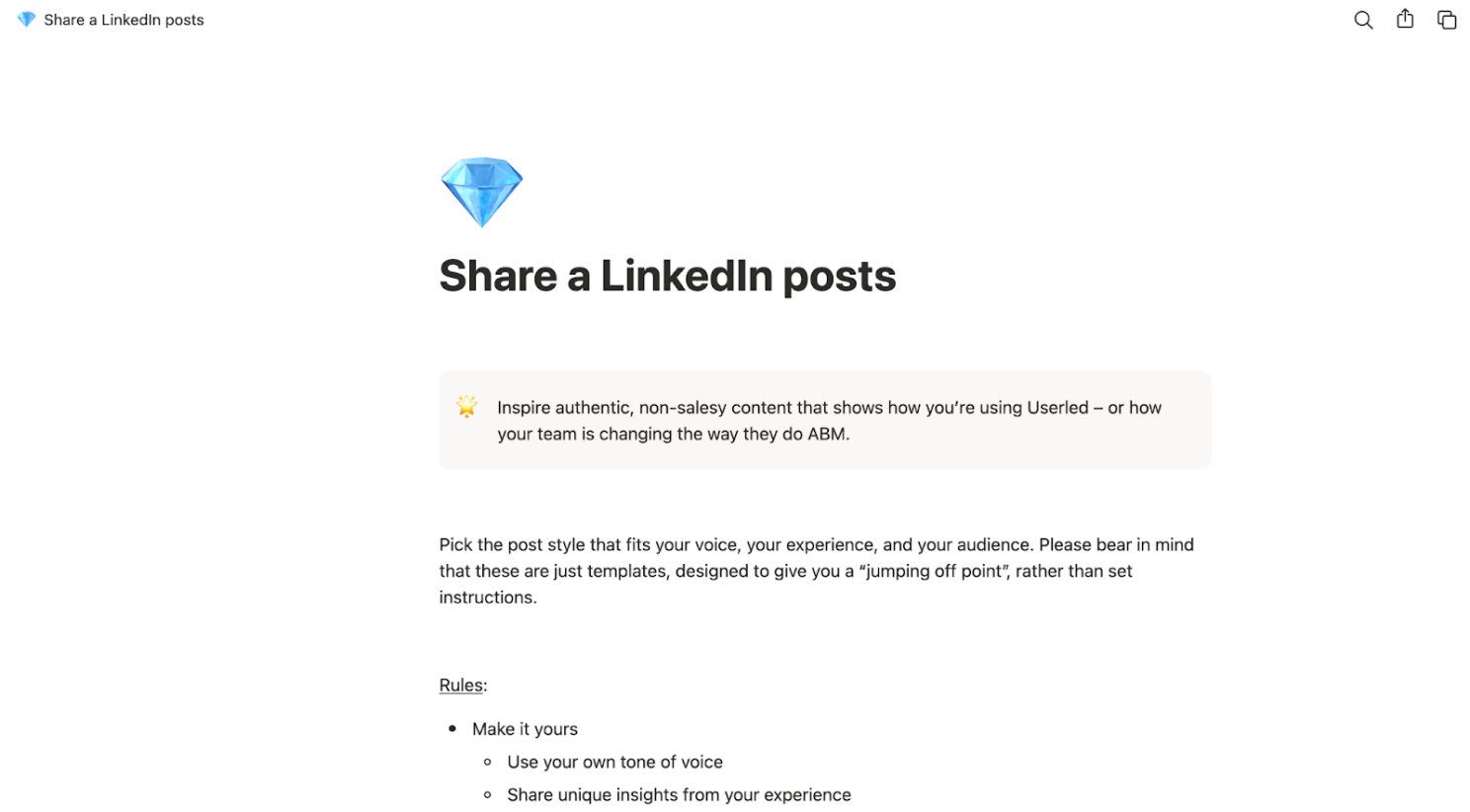

Customers are busy. If contributing felt like work, they wouldn't do it. If it felt like a two-minute guided process, they would.
- The Slack channel
We set up a dedicated Slack channel with all 30 participants – one shared space to communicate, share updates, celebrate wins, and keep energy high across 45 days.
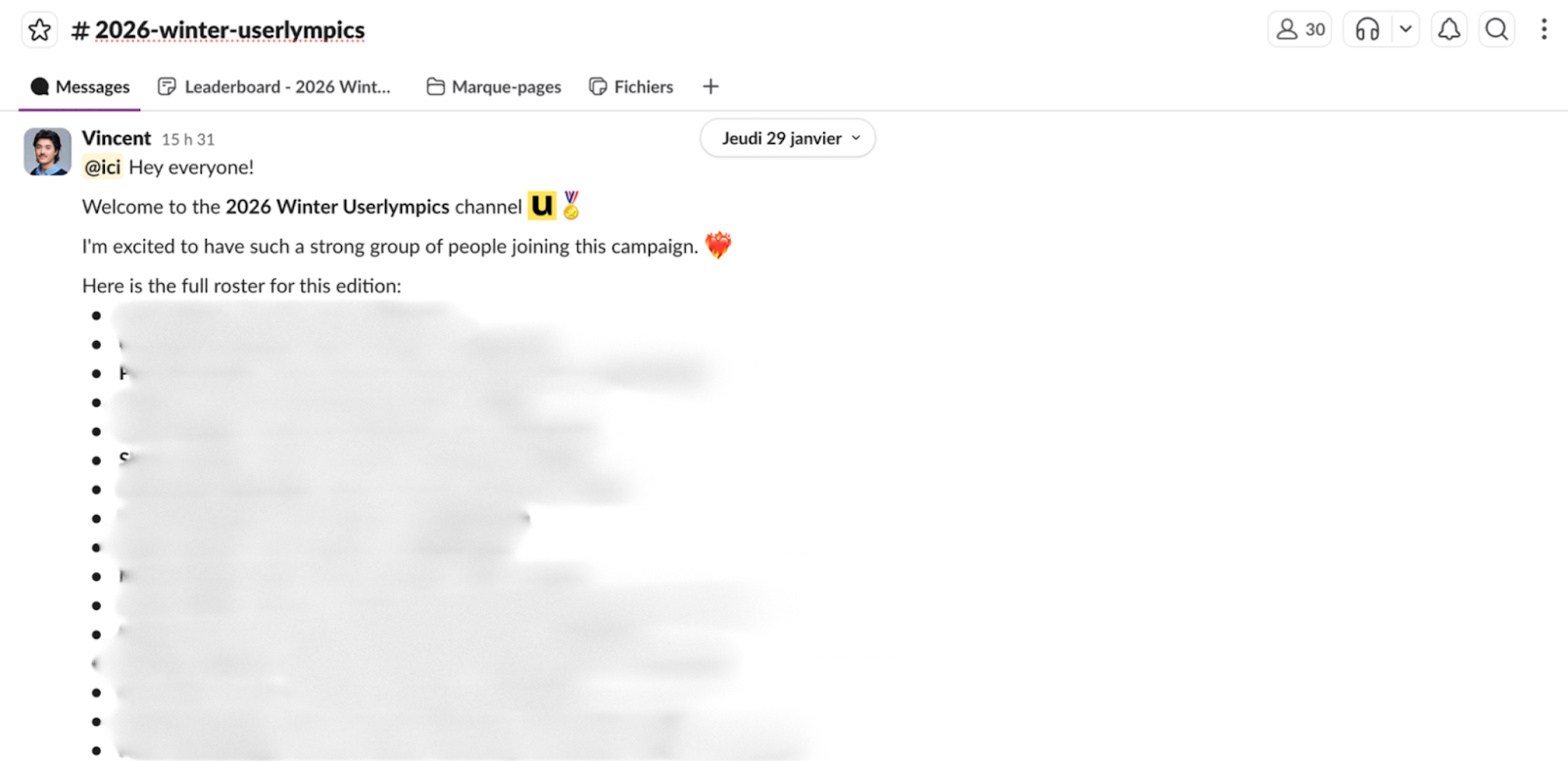
However, as some of our customers weren't on Slack (or inactive), we had to run a parallel track via LinkedIn and email to keep them engaged.
The lesson: don't wait until the end to adjust. If you see momentum dropping, you have levers – use them.
The gamification mechanics created the structure. The weekly touchpoints and mid-campaign adjustments created the momentum. You need both.
Keeping the engine running (the high-touch part nobody talks about)
Here's the thing about AI-powered tools: they need a human in the loop.
Yes, the leaderboard was built with AI. Yes, the Notion pages made things self-serve. But the campaign stayed alive because of consistent, manual, high-touch engagement – week after week.
That meant three things in practice:
1. Sharing participant posts back into the channel. Every time someone submitted a G2 review or published a LinkedIn post mentioning Userled, I'd drop it into the Slack channel with a reaction and some energy. It signaled to every participant that their contribution was seen and celebrated. That positive reinforcement kept people in the game.
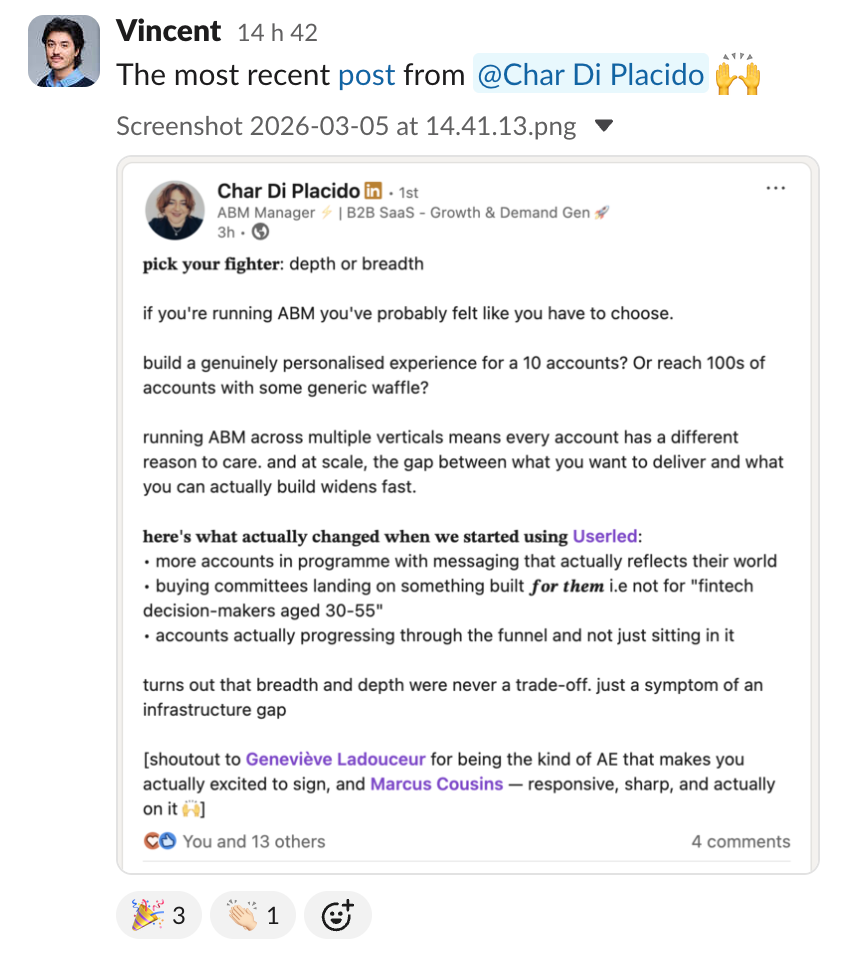
Then something amazing happened: participants started engaging with each other's posts. Commenting, sharing, reacting – without me prompting it. The channel became less of a broadcast tool and more of a small community. People were watching what others were doing, and it motivated them to act.
Our favorite moment of the campaign? When a participant emailed me out of nowhere asking me to update the leaderboard because he'd just completed another action, and wanted to ensure he was at the top.
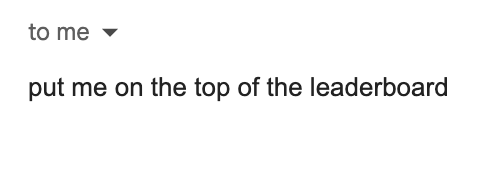
This kind of unprompted engagement is exactly what you're looking for. When a customer emails you to make sure their contribution is logged – you've won.
2. Sharing the leaderboard every week. Even though the leaderboard was live and accessible anytime, we sent a screenshot of the rankings into the channel every week. They could check it themselves, but sending it created a moment, a nudge, a reason to log back in and see where things stand.
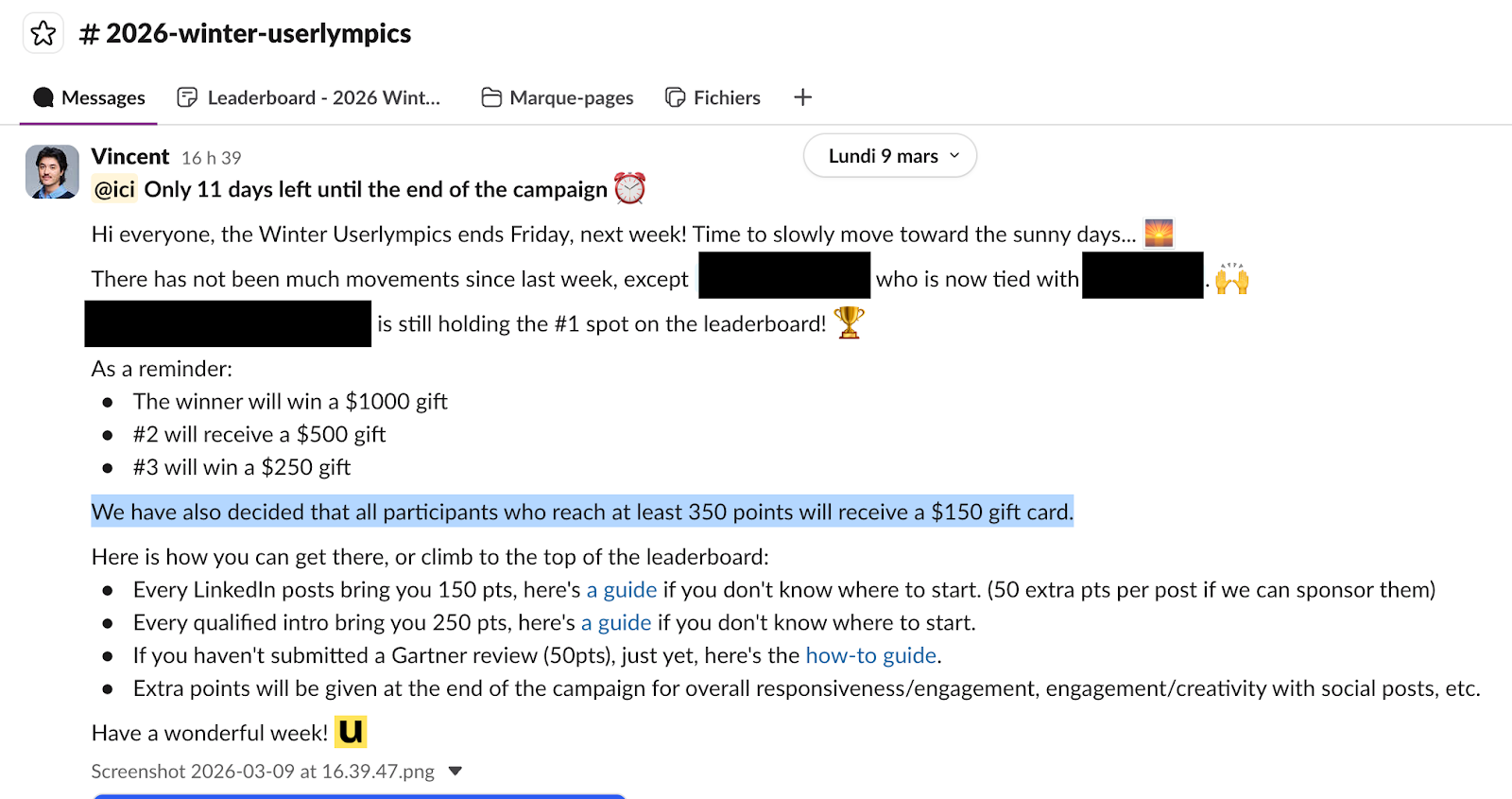
3. Introducing a mid-campaign threshold to re-ignite action. Halfway through the campaign, we noticed a pattern: a lot of participants had stalled. Not because they'd lost interest – but because they'd completed the easier actions and the remaining ones felt more resource-intensive. A qualified intro or a LinkedIn post requires more thought, more effort, and more commitment than clicking through a G2 form.
So we introduced a new incentive on the fly: reach 350 points, and your $100 gift card upgrades to $150.
Most participants were already close to that threshold without realizing it. The LinkedIn post – which was one of the most valuable actions for us in terms of ICP awareness – was often the one thing standing between them and 350. Same for a Gartner review.
That one change nudged a meaningful number of participants over the line. It made the LinkedIn post feel less like a big ask and more like the last step to unlocking something better.
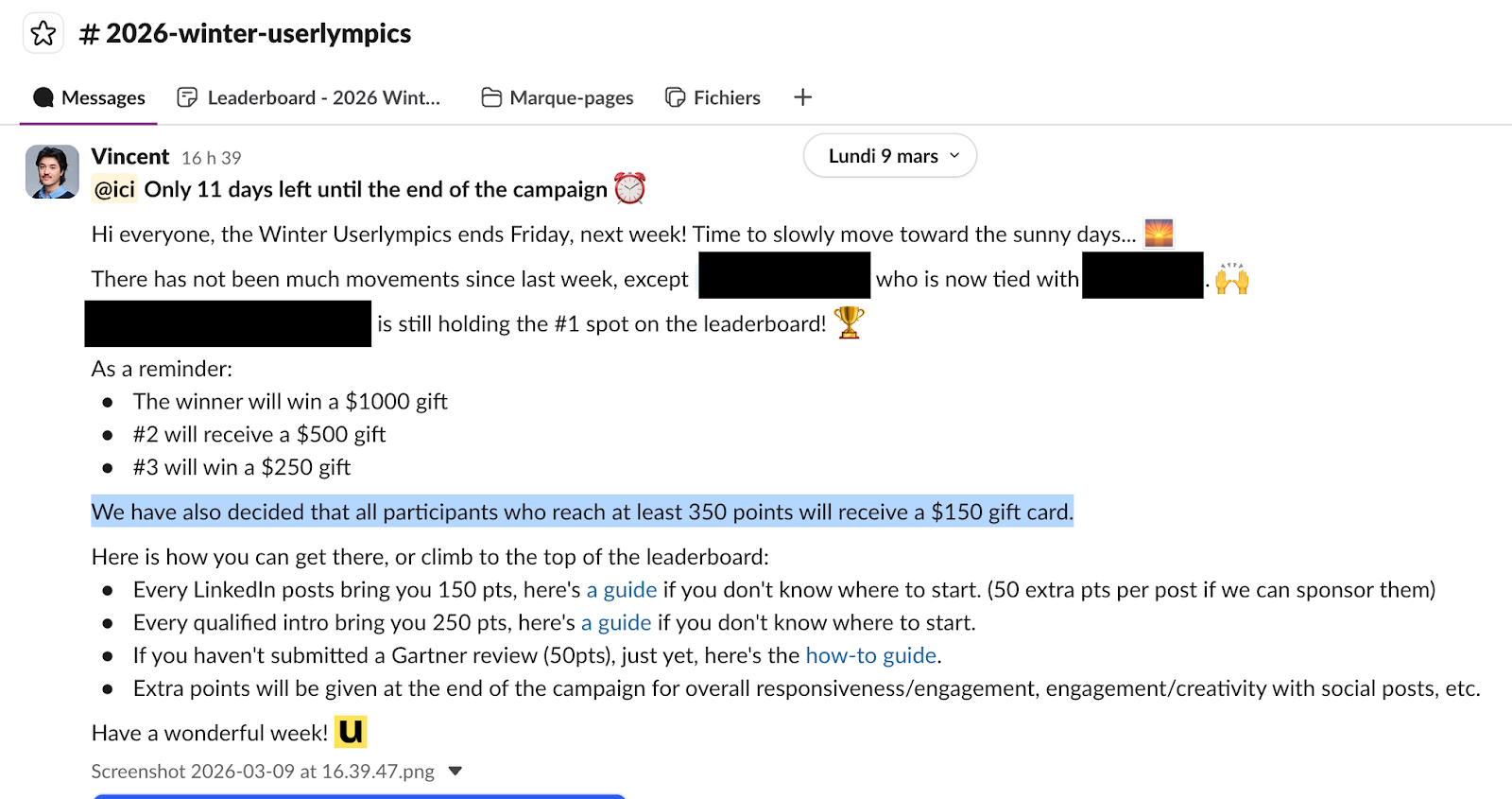
The lesson: don't wait until the end to adjust. If you see momentum dropping, you have levers – use them.
The gamification mechanics created the structure. The weekly touchpoints and mid-campaign adjustments created the momentum. You need both.
What happened when it ended
Let me separate what the campaign directly produced from what it unlocked downstream – because they're different things, and conflating them makes it harder to understand what actually drove what.
Direct outputs
G2: Userled named a High Performer in the G2 Spring 2026 reports – in two categories:
- Account-Based Content & Web Experiences
- Account-Based Orchestration Platforms
We ranked #2 in both Usability and Results.
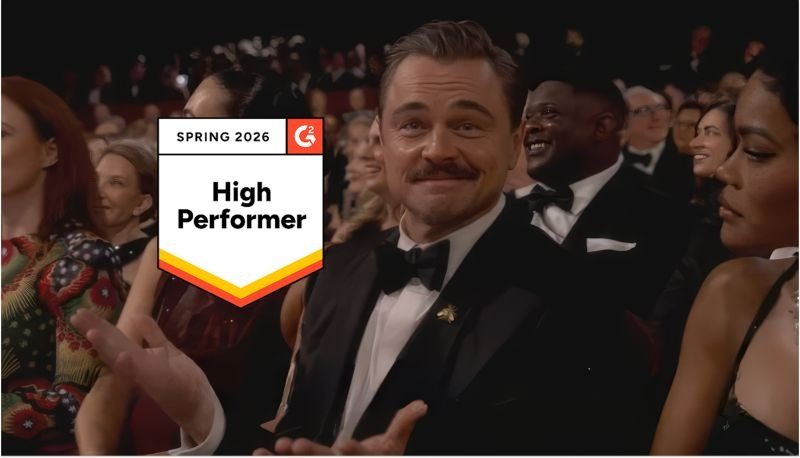
That's not a vanity badge. It tells a prospect who's shortlisting you that real practitioners at real companies voted you the best option. No ad can manufacture that.
LinkedIn posts: Our champions published a wave of content about Userled across their networks – reaching our ICP directly, in a voice that wasn't ours.
Downstream outcomes
Meetings: Our baseline is around 15 meetings per week – inbound and outbound combined, with an ACV of ~$40K. During and after the campaign, we saw 3 to 4x that number. Not from our outreach. From theirs.
When an ABM leader at a $bn company tells their network how they run ABM with Userled, that network listens differently than they listen to us. The trust transfers – and people book.
Pipeline: We're looking at $500K to $1M in pipeline value generated directly or accelerated by this campaign. Some deals have already closed. Others moved faster because a prospect had already seen a peer talking about us before we ever reached out.
The ROI reality check
We want to sit on a number for a second:
The total reward budget for this campaign – first, second, third place prizes plus gift cards for every other participant – came to roughly $5,000 to $6,000 in total.
Against $500K to $1M in pipeline, that's a 100x return on reward spend. At minimum.
I'm not aware of any paid channel – ads, events, outbound – that comes close to that. Beyond the pipeline, G2 named us a High Performer in two categories, we received dozens of authentic customer reviews, and created a repeatable playbook.
45 days. 30 champions. One leaderboard. That was the whole thing.
The most interesting thing we learned: not all champions are the same
This one surprised me – and it's probably the most strategically valuable insight from the entire campaign.
Some participants generated huge LinkedIn engagement. Lots of likes, comments, shares. Big numbers on the surface. But that engagement didn't necessarily convert into meetings or pipeline.
Others had smaller, quieter reach. Fewer likes. Less visible activity. But the right people were watching – and those posts directly led to meetings booked and deals moving.
Reach ≠ relevance. Engagement ≠ pipeline.
What this taught me is that among your customers, there are fundamentally different types of champions:
- Social amplifiers – great reach, strong personal brand, ideal for awareness and category building
- Pipeline drivers – smaller but more targeted audience, every post is seen by decision-makers who are ready to act
And here's the thing: you can start to predict which bucket someone falls into before you run the campaign, if you look at the right signals.
Pipeline drivers tend to be Directors or VPs at mid-market companies – people with real seniority, strong professional networks, and credibility that transfers. When they post about a tool, the people reading it are other senior decision-makers at similar companies. Their reach may be smaller, but their audience is exactly your ICP.
Social amplifiers tend to be more operator-level – earlier in their career, highly engaged with the product, genuinely passionate. They don't have the same network weight, but they create word-of-mouth in a different way. Their peers are other operators, other practitioners. It's a bottom-up motion – and it builds brand awareness in a layer of the market that the top-down approach never reaches.
Neither type is more valuable than the other. They're just valuable in different ways, for different goals.
Knowing which bucket each customer belongs to changes how you deploy them. And the only way to know for certain is to run a campaign like this and watch the data. But seniority, company stage, and LinkedIn presence are a solid starting point.
This is exactly where we want to take it next: segmenting champions by type and building campaigns tailored to what they're actually best at.
What I'd do differently
Scope it to 30 days, not 45. 45 days is too long. Momentum is hard to maintain over that timeline, and the last two weeks had noticeably less energy than the first three. A tighter 30-day window creates more urgency, more focus, and is frankly easier to manage for everyone involved.
Be honest about the time investment – and plan for it. The hardest part wasn't running the campaign. It was the setup. Building the leaderboard and admin panel in V0, creating the Notion playbooks for every action, defining the strategy – that took a few solid days of work before anything went live.
Once launched, it was lighter: roughly two to three touchpoints a week, maybe two hours total to share posts, update the leaderboard, respond to participants, and stay present in the channel.
That's manageable for one person. But it's not zero. And if you're running this alongside a full GTM workload, those two hours need to be protected.
Split campaigns by champion type. Now that we understand the difference between social amplifiers and pipeline drivers, the next campaigns will be more focused. For example:
- A social awareness campaign with all champions focused purely on LinkedIn presence and content
- An intro campaign with a smaller group of high-level strategic champions focused on warm introductions to target accounts
Different objectives, different mechanics, different audiences. One size doesn't fit all.
Ask about communication preferences upfront. Slack, email, LinkedIn DM – it doesn't matter which, as long as it matches where the customer actually lives. Assuming Slack works for everyone costs you engagement from day one.
What’s next?
This was our first test. A proof of concept. And it worked well enough that we're fully committed to making it a repeatable motion.
The cadence: We're planning to run a new campaign every four months, with new customers, evolving formats, and progressively bigger incentives for the top performers – giving champions more reasons to keep participating and compete harder as the program matures.
Beyond LinkedIn: The next iterations will push further – Reddit threads, co-creating content, and collaborating with customers.
The customer advisory board: Alongside the champion campaigns, one of our goals for 2026 is to build a formal customer advisory board with senior execs from our top accounts. People who can shape our product roadmap, challenge our thinking, and become true partners in how we go to market. The champion program is partly how we identify who belongs in that room.
We are more convinced than ever that it's the right bet for 2026.
Building a customer advocacy motion or thinking about ecosystem-led growth? Connect with me on LinkedIn, or send the Userled team a message.
P.S. Congratulations to our winner, Hugh Le from Alkira!
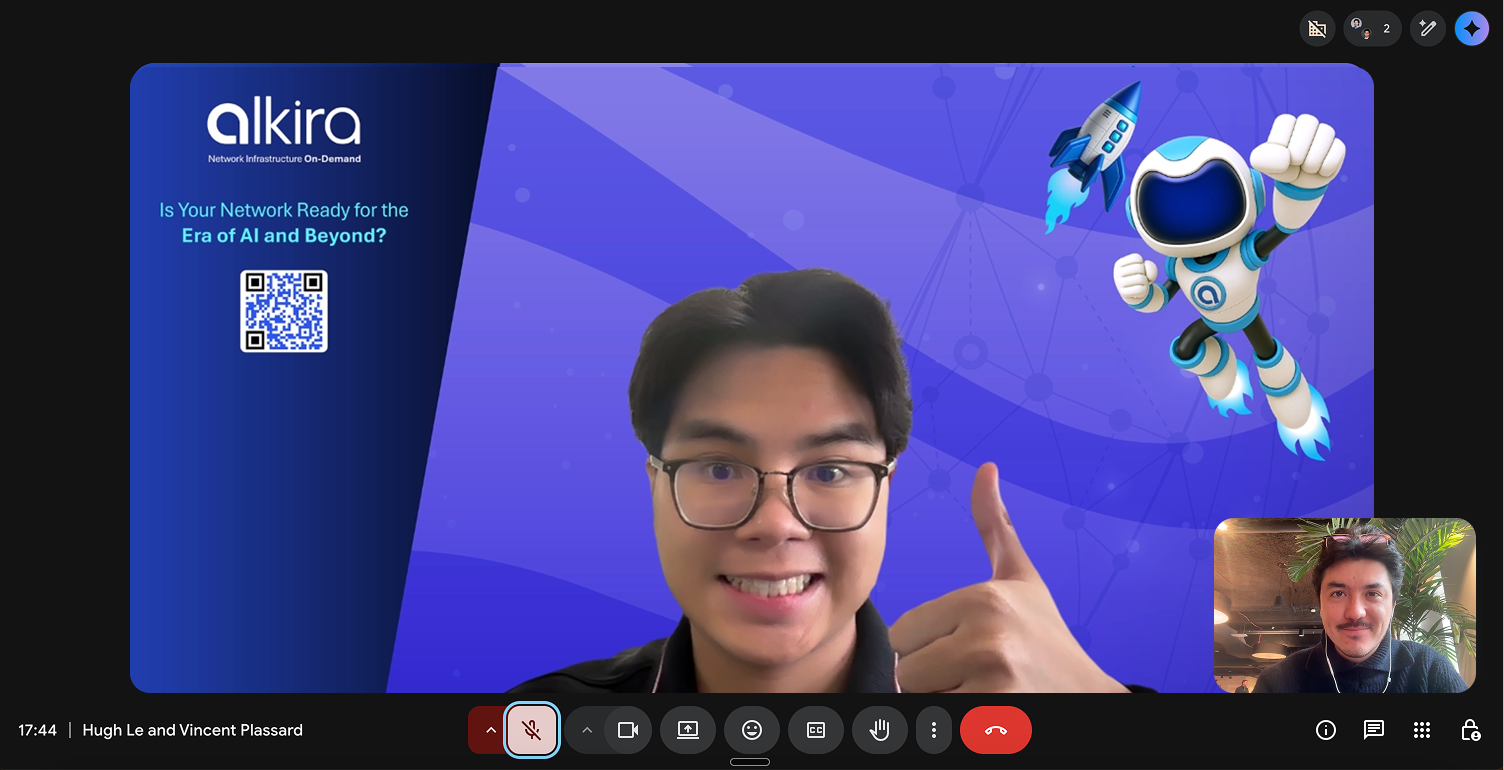
Generated £1.3M pipeline by focusing on UTM parameters personalisation.


Generated £1.3M pipeline by focusing on UTM parameters personalisation.
.png)
.png)