.png)
It’s almost 2026, and yet too many enterprise GTM teams are still operating like it’s 2015.
They’re stuck in the same outdated patterns – long, drawn-out campaign cycles, bloated platforms they barely use, and “ABM” programs that take months to launch, only to deliver the same underwhelming engagement metrics. The tech has changed. Buyers have changed. And even budgets have changed. But the playbooks remain the same.
We’ve seen it firsthand.
Every week, we talk with dozens of ABM and marketing leaders. And while intent data, predictive analytics, and AI tooling have advanced dramatically, execution still moves at a snail’s pace. Or worse – is outsourced before teams are even ready.
We call this the ABM Maturity Gap:
- Teams invest in technology before they have the operational readiness to use it.
- Agencies are brought in too early, before strategy and ICP alignment are locked.
- ABX is treated like a “someday” project instead of a mandatory motion.
Meanwhile, pipeline targets are growing, ad platforms are saturated, and trust in generic outbound is falling fast. Add in headcount freezes and tool audits, and GTM leaders are under pressure like never before.
That’s why we built Userled around one core belief:
ABM should move at the speed of now.
In 2026, delivering 1:1 experiences to key accounts shouldn’t take months. It should take days. When a decision-maker hits your pricing page or engages with an ad, that signal should route to the right person instantly. Every interaction should open a door – not sit silently in a dashboard.
In this post, I’ll walk through the GTM framework we use – from budget structure to tech stack to execution velocity – and how we’re helping modern ABM teams scale personalized, high-impact engagement without the legacy baggage.
Let’s start by breaking down the most common traps that keep GTM teams stuck.
The 3 mistakes slowing down enterprise GTM in 2026
Despite the rapid evolution of buyer behavior and tools, many GTM and ABM teams are stuck repeating the same costly patterns. And the cost isn’t just budget – it’s pipeline velocity, deal momentum, and ultimately revenue.
Here are the three most common traps we see in enterprise marketing today:
1. Buying tech before you’re ready
We’ve watched this happen on repeat: a team signs a six-figure ABM platform contract before aligning internally on ICP, workflows, or what “account-based” even means to them.
When the foundations aren’t in place – clear buyer journeys, signal routing, sales/marketing alignment – no amount of tech will save the strategy. Tech isn’t a strategy shortcut. It’s an amplifier. If the underlying process is broken, disappointing results will just arrive faster..
At Userled, we intentionally work with companies who are ready to scale enterprise-grade 1:1 experiences for their key accounts – not just check a box labeled “ABM platform”.
2. Outsourcing too soon
We love agencies and partner with great ones, but we also know that outsourcing ABM execution too early is like outsourcing your product strategy before talking to your customers.
Agencies work best when the internal GTM team already has a solid handle on their ICP, messaging, and workflows. Without that maturity, teams end up paying for slide decks, not outcomes.
ABM isn’t just about execution – it’s about learning. Internal teams need to build the frameworks that make it work: fast feedback loops, campaign iteration, and stakeholder alignment. Without that, even great creative or media plans can fall flat.
3. Assuming ABM has to be big, slow, and expensive
This one’s personal. We hear it constantly: "We love the idea of 1:1 personalization... but we don’t have the team for it” or "It sounds great, but our ABM program already takes months to build”.
This belief – that account-based marketing is complex, expensive, and slow – is killing velocity across marketing teams.
We’ve proven it doesn’t have to be this way. With just two marketers, we’ve launched hundreds of 1:1 microsites per month, coordinated 1:1 LinkedIn ad campaigns, and helped sales deliver tailored content at scale – all without bloated workflows or months of lead time.
This not only has generated millions of pipeline, but have helped us win deals against competition by showing our target accounts that we genuinely care about working together.
The secret? Smart orchestration, not headcount.
ABM at the speed of now means speed to activation, speed to signal, and speed to meeting.
A new ABM model for enterprise teams
The old GTM blueprint – heavy headcount, slow-moving campaigns, and static content – simply doesn’t hold up in today’s enterprise landscape. Attention spans are short, deal cycles are long, and expectations for personalization are at an all-time high.
We’ve rebuilt our GTM model around three key principles: lean teams, orchestrated tech, and measurable velocity.
The stack: flexible, lean, orchestrated
We don’t believe in stacking tools for the sake of it. Every part of our stack plays a clear role in routing signals, scaling relevance, or accelerating pipeline.
These tools all drive GTM velocity and repeatability while working and communicating seamlessly with other platforms.
Here’s our 2026 GTM stack
- Userled – 1:1 ads and microsites that accelerate enterprise deals
- Cargo – GTM orchestration, workflow automation, and agents for sales
- Pletor – visual storytelling for ABM content
- v0 + AI models – rapid campaign prototyping and experimentation
.png)
The future isn’t more tech – it’s better orchestration.
Budget allocation: built for velocity, not vanity
Our GTM budget sits between 10-12% of revenue – which may sound modest, but it’s designed for maximum flexibility and compounding returns.
Here’s how we allocate it:
- Events (~45%): High-touch, high-return. Events drive pipeline, strengthen deals, and deepen relationships.
- Paid Ads (~20%): Personalized ads that engage and convert our top-tier accounts, and accelerate deals.
- Contractors (~15%): AI doesn’t mean more headcount, but it doesn’t mean understaffed either. Some necessary resources like web, design, and video, are done with experts.
- Tooling (~10%): this is spent on orchestration (ABX, GTM, brand).
- Campaigns (~10%): Customers and influencers campaigns, experiments, tactical bets on new formats, channels, or creative ideas – often used alongside AI and gifting.
.png)
This structure allows us to move fast, experiment without chaos, and double down when something works. Think modular content, playbooks, and scalable campaign infrastructure that’s mostly done in-house.
Predictability comes from systems. Creativity comes from room to explore.


ABM orchestration in practice
Every GTM strategy is only as good as its execution. The faster your team can move from insight to action, and from signal to conversation, the more pipeline you generate.
That’s why orchestrating 1:1 engagement across the funnel is key. Here’s what it looks like with Userled.
How Userled integrates into the ABM stack
Userled doesn’t replace your existing intent or data platforms – it activates them.
It integrates with systems like Salesforce, 6sense, Demandbase, Cargo, and your data warehouse to create personalized experiences based on buyer signals, helping to drive real pipeline.
Unlike legacy tools like PathFactory or Mutiny, which often feel like expensive content management systems with a dashboard, Userled puts GTM teams in control of delivering personalized assets and engagement insights that sales can use immediately.
When a key buyer clicks an ad or visits a microsite:
- Engagement is captured.
- The right AE or BDR is notified instantly.
- The interaction is routed via Slack, email, or CRM – depending on what’s fastest.
- The follow-up is contextual, timely, and relevant to that account.
We don’t just track signals. We help you act on them.
Unlocking velocity with 1:1 LinkedIn Ads
This year, we launched a new feature: the ability to spin up 1:1 LinkedIn ad campaigns at scale. The goal? To help GTM teams move beyond generic paid ads and speak directly to decision-makers inside their top-tier accounts, within days.
We tested it ourselves, and in just a few weeks:
- We launched hundreds of personalized ad variations.
- Our pipeline from high-priority ICP segments grew noticeably.
- Deal velocity increased – not just from faster meetings, but cleaner handoffs and deeper engagement per account.
- And importantly, we did it without ballooning ad spend.
This wasn’t a vanity play. It was a signal-to-meeting engine.
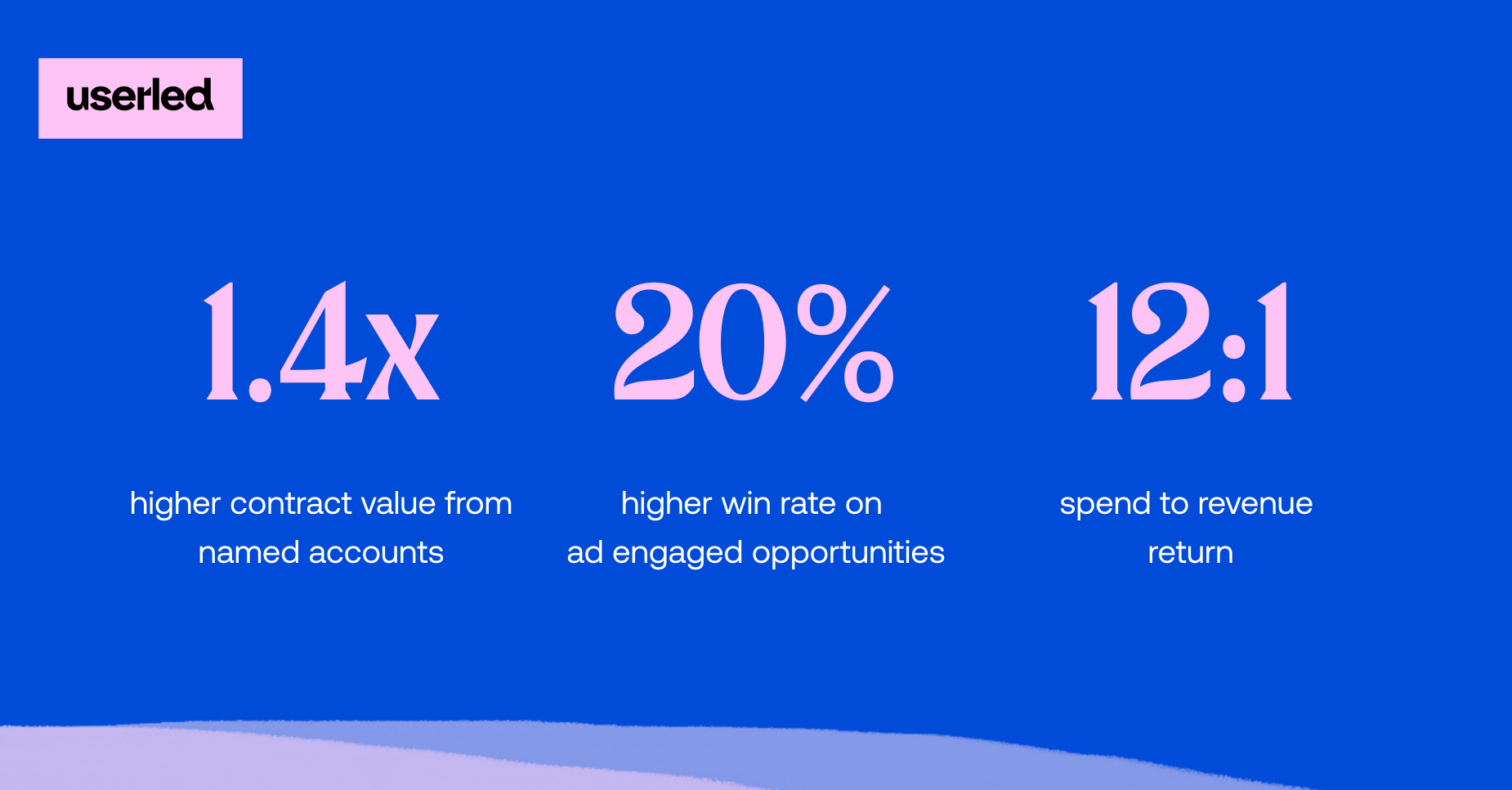
Userled doesn’t require massive budgets or long timelines. With the right signals, a small GTM team can move with speed and precision – and drive results that most ABM teams take quarters to replicate.
Lean teams, large impact
One of the biggest misconceptions about enterprise ABM is that it requires a large team to do it well.
We’ve proven the opposite.
Our marketing team is just two people – and yet we’re running high-impact, full-funnel ABM campaigns every week.
How? Because we’ve built for speed, not size, and because orchestration isn’t limited to marketing anymore. Sales is an active player with 1:1 high-touch engagement (enabled by our recent release of the Sales Plugin), and AI-enhanced workflows multiply our reach.
How we scale without scaling chaos
Here’s what “ABM at the speed of now” looks like in action:
- Hundreds of microsites created monthly: we empower AEs and SDRs to generate and share custom microsites with their top accounts. No bottlenecks. No design tickets.
- Hundreds of 1:1 ads launched quarterly: with Userled’s ad personalization layer, we dynamically serve LinkedIn ads tailored to each buyer persona and ICP segment – without spinning up new campaigns from scratch.
Signal-based workflows: when a prospect engages with a microsite or ad, it doesn’t sit in a dashboard. It routes immediately to the right person with context – so follow-ups happen fast.
We’ve even seen small startups – some with zero dedicated marketers – use Userled to build effective enterprise campaigns that punch way above their weight. Because once the GTM foundation is in place, execution becomes a matter of signals, speed, and orchestration.
The KPIs that actually matter in modern ABM
You can’t optimize what you don’t measure – but measuring the wrong things is just as dangerous. Too many GTM teams still focus on volume metrics that don’t correlate with pipeline, let alone revenue.
If you’re running 1:1 ABM campaigns, here’s what should be on your dashboard:
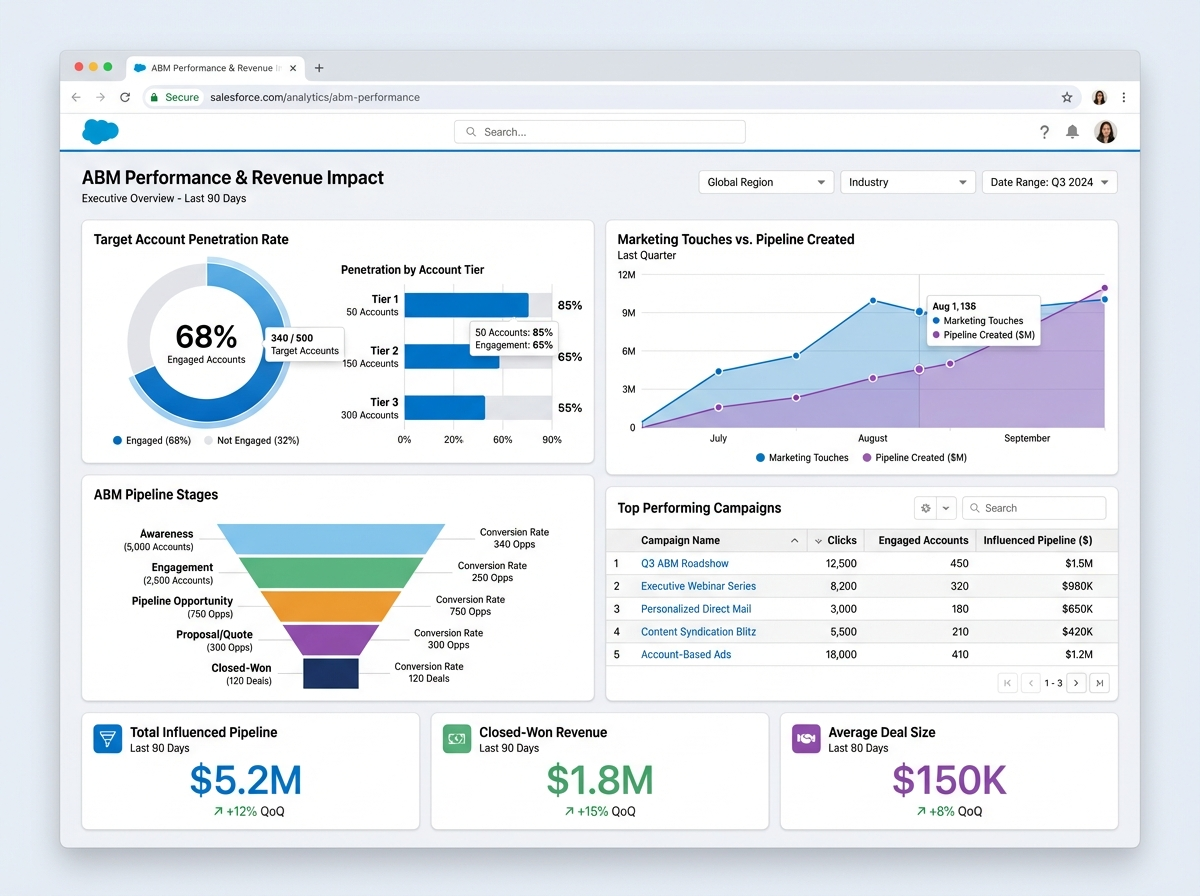
1. Target account penetration rate
Are you actually reaching and engaging your most important accounts?
Track:
- % of tier-1 accounts with meaningful engagement (clicks, site visits, ad views)
- % of target accounts with multiple personas activated
Why it matters: Penetration = presence. If they’re not engaging, they’re not progressing.
2. Pipeline velocity
It’s not just about generating pipeline – it’s about how fast it moves.
Track:
- Average time from first signal (e.g. ad click) to meeting booked
- Time from meeting to opportunity creation
- Time to close for personalized vs. non-personalized journeys
Why it matters: Shorter cycles = less friction + more predictability = better revenue planning.
3. CLTV from engaged accounts
ABM is a long game. Look at what happens after the deal.
Track:
- Customer lifetime value by engagement tier
- Expansion velocity post-signature
- Retention and upsell rates on accounts that engaged with 1:1 content
Why it matters: Higher engagement leads to deeper relationships – and longer revenue tail.
4. Signal-to-action rate
Most teams capture signals. Few act on them fast.
Track:
- % of microsite visits routed to the right AE within X minutes
- % of engaged buyers followed up within 24 hours
- Lead-to-response speed for 1:1 ad clicks or site visits
Why it matters: Timing kills deals. Routing and speed are the new conversion levers.
5. Cost per 1:1 activation (A more modern take on CPL)
Generic cost-per-lead is meaningless in an enterprise motion. Instead, track what it costs to deliver qualified, personalized touchpoints.
Track:
- Cost per 1:1 ad served to target account
- Cost per engaged microsite visitor from a high-priority account
Why it matters: These are the true “unit economics” of 1:1 ABM.
If your dashboards don’t show engagement depth, routing speed, and velocity by segment, you’re missing the levers that actually move pipeline.
Personalization across the full funnel
Most ABM platforms focus on the top of the funnel – flashy ads, firmographic targeting, and maybe a dynamic headline swap on a landing page. But enterprise deals don’t close on the first click; they’re complex, multi-threaded, and require orchestration across marketing, sales, and post-sales.
That’s why we designed our platform to power personalization from the first impression to the final decision.
Here’s what that looks like:
Top-of-funnel: standing out with 1:1 ads
- Use LinkedIn and paid media to serve personalized ads for each account.
- Dynamic creative matched to industry, role, stage, or product fit.
- Higher engagement without higher spend, thanks to tighter targeting and relevance.
Result: More clicks from the right people – not just more impressions.
Mid-funnel: engaging with personalized microsites
- Each key account gets a tailored microsite with content mapped to their needs: use cases, testimonials, pricing, product walkthroughs.
- Shared by sales, embedded in outreach, or triggered via remarketing flows.
- Microsites aren’t static – they adapt based on engagement patterns or signal intent shifts.
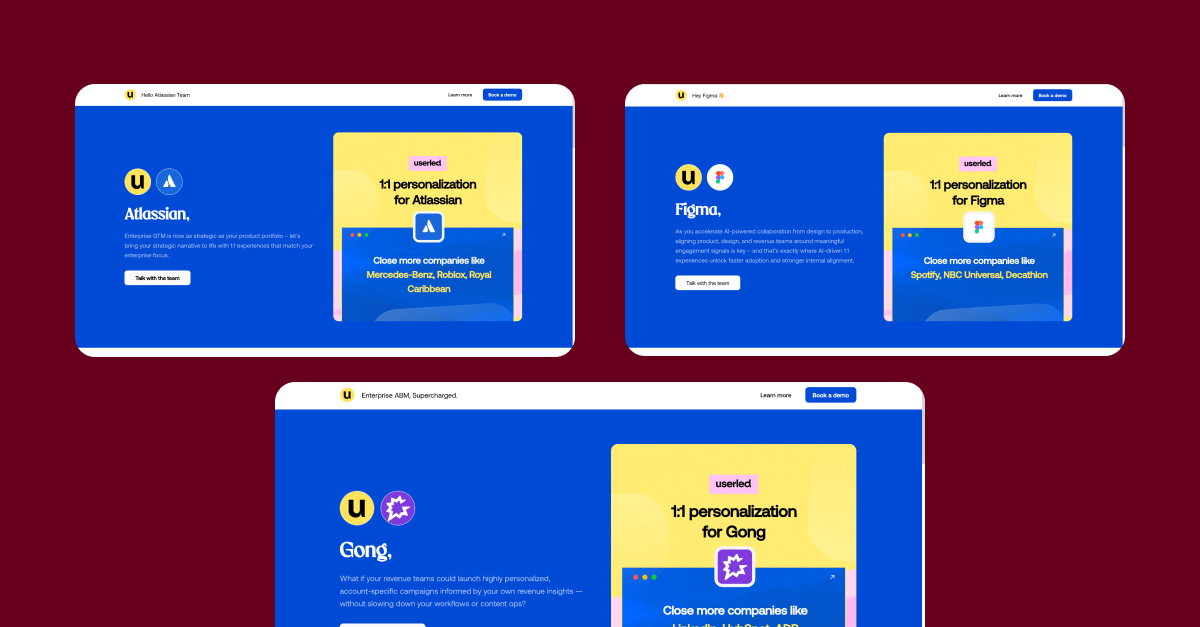
Result: Better deal support, more stakeholder activation, deeper alignment between sales and marketing.
Bottom-funnel & post-sale: supporting deals and expansion
- Use Userled to support late-stage conversations with tailored pages for legal, security, procurement, etc.
- After the deal closes, continue the experience with personalized onboarding or upsell microsites.
- Integrate with CS and account teams to expand usage and value.
.png)
Result: Deals close faster, accounts expand faster, relationships last longer.
ABM shouldn’t stop at pipeline. With Userled, personalization becomes a full-funnel motion – from first click to renewal.
From chaos to clarity: making every touchpoint count
In enterprise GTM, it’s no longer enough to generate pipeline. You have to earn it.
Buyers are overwhelmed, inboxes are flooded, and more often than not, outreach is forgettable..
And that’s exactly where the gap is. Most GTM programs still operate on generic content and batch campaigns – even in “ABM”.
The irony? The accounts that matter most are treated the same as everyone else.
Modern ABM is about intentionality.
It’s not about flooding the funnel. It’s about choosing the accounts that matter – and delivering tailored, relevant, and timely experiences that can’t be ignored. .
High-velocity personalization at every stage ABM isn’t just a strategy.
It’s the standard for how every moment is designed, delivered, and remembered. Whether it’s the first ad a prospect sees, the microsite they land on, or the follow-up from your sales team, every experience should feel like it was made just for them.
That’s how you stand out. That’s how you win.
Great ABM isn’t about volume, but about precision – at speed.
With Userled, you can:
- Launch 1:1 ads in hours, not weeks.
- Personalize microsites per account or persona.
- Enable Sales to scale tailored outreach without bloating headcount.
- Support deal stages with content mapped to every stakeholder’s need.
It’s not just about reacting to signals – it’s about designing experiences that create them.
It’s time for ABM at the speed of now
The biggest threat to GTM in 2026 isn’t competition – it’s inertia, but moving at speed requires discipline.
In 2026, the gap between average and exceptional teams will come down to one thing:
Who can deliver personalized, memorable experiences – faster – and more intentionally?
We believe modern ABM isn’t about flashy tech stacks or long planning cycles. It’s about making every interaction matter, choosing the right accounts, and showing up in a way they’ll remember.
Winning brands deliver relevant, impactful campaigns across the entire buyer journey in hours, not months.
ABM at the speed of now means:
- Giving your GTM team the tools to act on opportunity without bottlenecks
- Turning intent into interaction, and interaction into pipeline
- Creating 1:1 touchpoints that leave a mark – at every stage of the deal
And you can do it all without a 30-person team or a six-figure tech stack.
Userled powers exactly that – because we’ve lived the chaos, and we know what it takes to break out of it.
So the real question is: are you still building your GTM strategy for 2015? Or are you ready to operate like it’s 2026?
Author

Generated £1.3M pipeline by focusing on UTM parameters personalisation.


Generated £1.3M pipeline by focusing on UTM parameters personalisation.
.png)
.png)