

.png)
Buyers don’t really have inboxes anymore.
If you’re running ABM or a GTM team, you’ll know exactly what I mean.
Between the pandemic and the explosion of AI, every key decision maker started receiving hundreds, if not thousands, of emails from tenacious salespeople.
But guess what? Just a fraction of those messages are ever opened, even fewer are read, and almost none get a reply.
Why? Because senior decision makers at your target accounts are juggling Slack ping overload, back-to-back calls, priority requests, and a never-ending stream of “quick check-ins” from sales.
It’s not that they’re uninterested in new products or solutions, but that they don’t have time for generic, problem-unaware outreach.
So if your follow-up strategy is basically, “add another step to the sequence and tweak the first line,” it’s not just underperforming. It’s invisible.
The real reason why your follow-up feels forgettable
Without a doubt, it’s an interesting, yet challenging time for sales outreach: attention is scarce, AI content is cheap, and the only real filter your buyers trust is:
“Do these people actually understand my world, or are they just spraying templates?”
And honestly? Most of the time, they can tell.
Here’s the thing: a lot of reps are underequipped and flying half-blind – not only are they sharing generic assets and links, they also can’t see page opens or clicks.
Sure, maybe they’ve got some intent data floating around somewhere, but it’s in yet another tool they have to navigate to, and they still don’t know:
- Who at the account is genuinely interested
- What people are spending time on
- When interest actually spikes
So they guess, bump up emails, stick to patterns, and interrupt stakeholders on LinkedIn with: “just circling this back to the top of your inbox.”

All the while, outreach cadences are running on rails. Day 1. Day 3. Day 7. Day 14.
But prospects don’t move in neat patterns. There’s no telling when someone at a high-priority account might:
- Read a case study over lunch
- Share a pricing page in a Slack channel
- Forward a deck to their VP the same afternoon
The worst part? Your system is still sitting there, patiently waiting for Step 4: Follow-up #2.
By the time the “timely nudge” goes out, their interest has either cooled or shifted.
Now, layer on the personalization problem.
Most “personalized” emails still look like this:
“Hey Sarah, I loved your recent post on LinkedIn about data-driven decision making…”
It’s not wrong. It’s just… thin. It doesn’t show you understand what her team is being measured on this quarter, where she’s under pressure to move faster, or how her team’s existing technology stack (or headcount) constrains her options.
Every sales pro understands that real relevance requires context, but pulling it together for every important account takes time that they simply do not have. So, they settle for swapping a line or two, hit send, and hope volume makes up for the lack of depth.
And whenever a big, strategic account comes along, everyone turns to marketing, asking:
- “Can you make us a custom deck?”
- “Do we have a case study that’s exactly like this?”
- “Could you create a landing page just for them?”
And marketing wants to help, but they also have launches, campaigns, brand work, and about 73 other priorities. They can’t churn out bespoke assets for every rep, every opportunity, every week.
So the same old machine keeps running.
More touches. More noise. Same outcomes.
What “good” looks like in 2025
If you look at the B2B brands that actually stick in your head, they’re not winning because someone found a slightly better email template.
They’re winning because every experience is tailor made.
Rather than pumping out assets, these brands use every touchpoint as an opportunity to delight, from awareness ads through to bespoke demos.
By rolling out the red carpet and tapping into what their customers care about, these brands encourage prospects to use their products or services.
These brands all:
- Craft stories that map to specific industries and roles
- Orchestrate touchpoints around real moments of interest
- Make prospects feel like, “Okay, they actually get our situation.”
The contrast between this and a cold email from a salesperson that might as well have gone to 5,000 people is brutal.
So why is it that while marketing teams are rolling out experiences that feel like movie premieres, why does sales outreach still feel like filling out a government form?
This gap, the one between the experience a brand could deliver and the reality of follow-up, is where enterprise pipeline quietly leaks away.
From messages to moments
So what does a better standard for outreach actually look like?
It comes down to three things:
- Timing – acting when interest is actually there, not when a cadence step says so
- Relevance – giving people something that feels tailored to their context, not just their name
- Trust – proving, repeatedly, that you understand their world and can help
When someone leans in, hits your page, clicks a resource, or shares something internally – you have to respond with something sharp, specific, and useful.
And it can’t be three days later with a recycled paragraph, or a note that says “just checking whether you saw my last email?”
The catch: doing this for every important account with manual effort alone? That’s fantasy.
So we asked a different question:
What if reps could create rich, 1:1 experiences for any prospect in seconds and at scale as part of their daily workflow?
Meet the Userled Sales Plugin
That question is what led us to build the Userled Sales Plugin.
It’s a browser extension that lives where reps already spend their time: on LinkedIn, in HubSpot, in Salesforce – and turns those places into launchpads for 1:1 sales experiences.
No new tool to “adopt.” No separate platform they have to remember to log into. It just sits there until they need it.
Creating 1:1 microsites in the flow of work
Picture this. You’re on LinkedIn, looking at the profile of a VP at a dream account. Normally, you’d send a connection request, maybe a short note, then add them to a sequence and move on.
With the Sales Plugin, you click the extension instead and it immediately identifies who you’re looking at and which account they belong to.
You choose a template your marketing team has already designed or generate your own.
Then, you drag in a few relevant assets: a case study from their industry, a short product walkthrough or demo snippet, and a one-pager that talks to their likely use case.
In a couple of clicks, you’ve created a personalized microsite just for them.
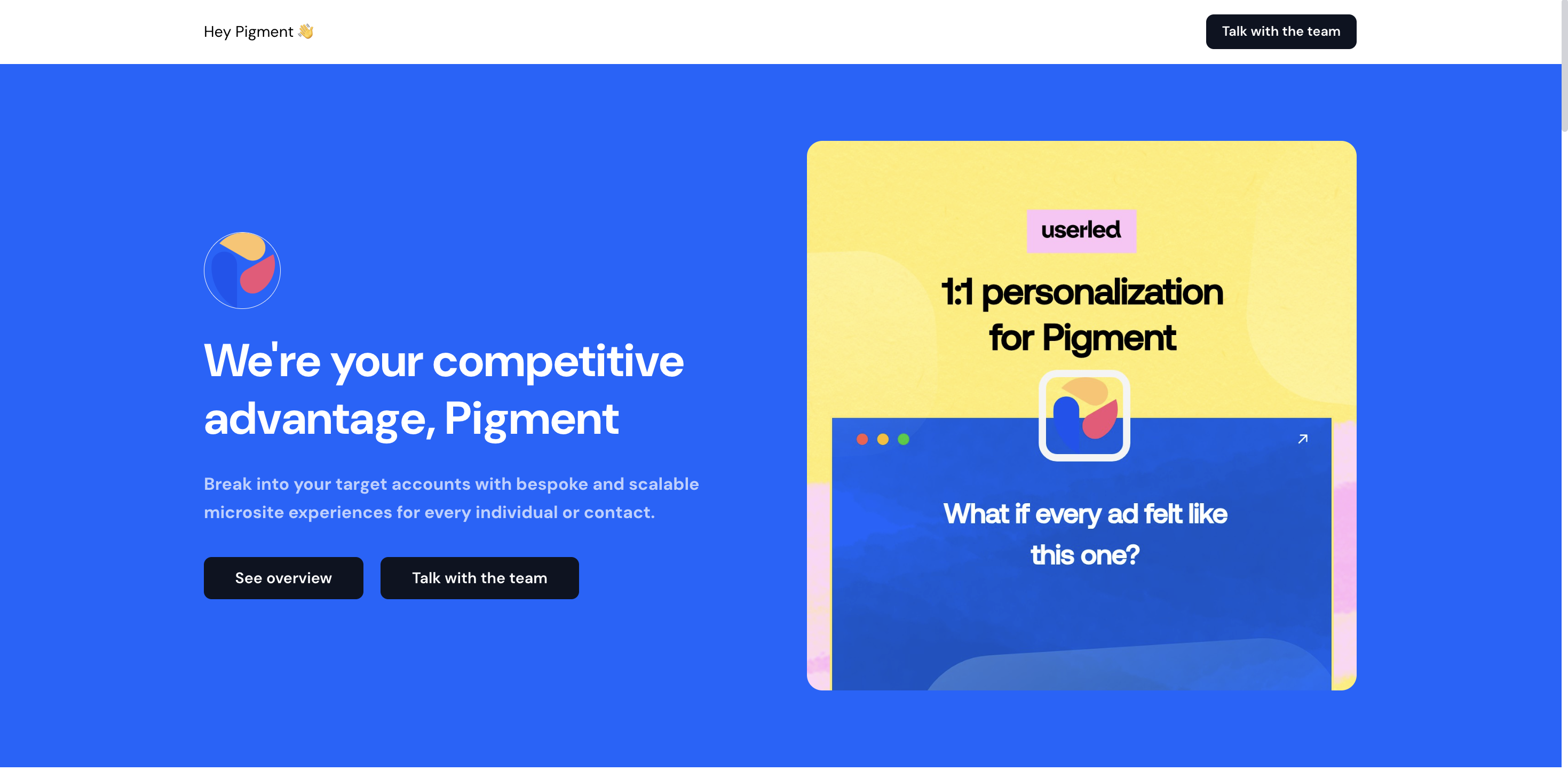
Not a long email thread full of links, or a generic marketing landing page.
A contained, on-brand experience that quietly says: “This is for you.”
The same thing works from your CRM. You’re in HubSpot or Salesforce, reviewing a stalled deal or a new contact at a key account. Instead of thinking, “What do I send?” you:
- Open the companion
- Spin up a fresh page for that account
- Share it with your champion and ask them to pass it around internally
All without leaving the tab you’re already in.
Marketing still controls the templates and the brand. Reps control when and how those experiences get used.
Signals that actually move the needle
But creating better experiences is only half the story.
The moment a prospect clicks on that page, something equally important happens: you know.
The Userled Sales Plugin sends the rep real-time engagement signals the second someone interacts with their microsite. This includes:
- Who visited
- Which sections they viewed
- What they clicked
- When new people from the same company showed up
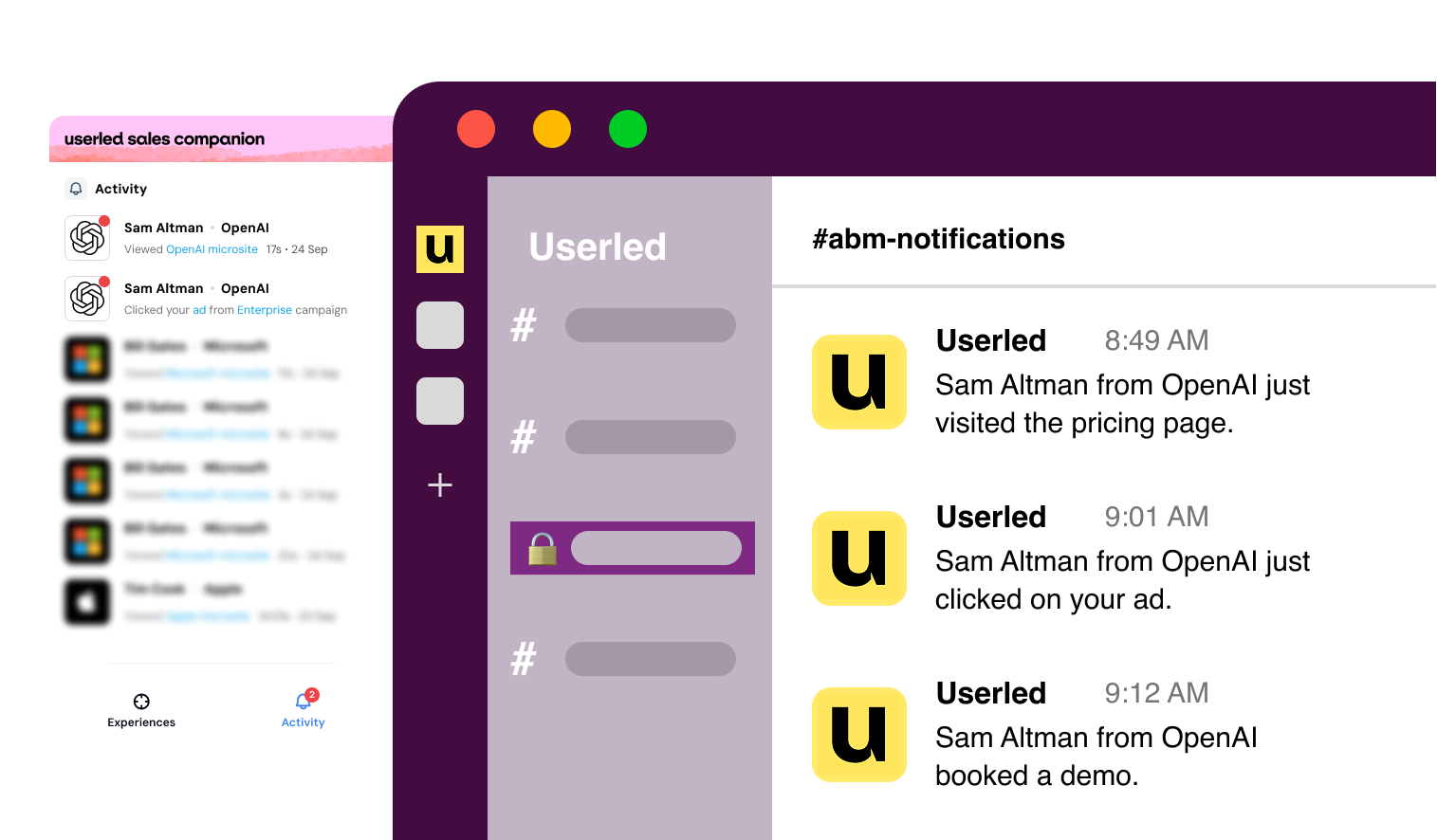
Suddenly, reps are no longer guessing.
They’re not sending a random bump because “it’s been three days.” They’re responding to visible, specific behavior.
Instead of: “Just checking in to see if you had a chance to look at this…”
You get:
“Hey Maya, I saw you spent some time on the workflow section of the page I sent over. I pulled together a quick view of how teams with a similar stack rolled this out without disrupting ops – want me to send it?”
Same channel. Same rep. Same prospect.
Completely different energy.
You’re paying attention. You’re relevant. You’re on time.
What this unlocks for GTM leaders
When you put all of this together, the motion shifts.
Reps start to think less in terms of “steps in a cadence” and more in terms of moments they can create and respond to.
- LinkedIn stops being just a place to scrape names; it becomes the starting point for tailored, sharable experiences.
- HubSpot and Salesforce stop being just systems of record; they become control rooms for who’s engaging and what to do next.
- Marketing stops being the bottleneck for “anything custom”; they define the system, then let reps operate within it at speed.
And you, as a leader, get a clearer view of reality:
- Which accounts are actually warming up
- Who inside those accounts is engaged
- What content consistently gets attention and moves deals forward
That’s the kind of insight you can build a modern follow-up playbook on.
Check out what we're building below.
Where you go from here
You don’t need to rebuild your entire GTM motion to take a step in this direction.
You could start with something as simple as:
- Pick a small set of strategic accounts where follow-up currently feels generic.
- Have your reps use the Userled Sales Plugin to create simple, targeted microsites for those accounts – from LinkedIn or straight out of HubSpot/Salesforce.
- Replace one “standard” step in your sequence with an experience-led touch that links to that page.
- Ask your reps to follow up only when they see real engagement signals – and tailor those follow-ups to what people actually viewed.
Then compare. Meetings booked. Reply rates. Number of stakeholders involved. Deal momentum.
In a world where AI can generate a thousand cold emails in a few seconds, the winning move isn’t “send more”, it’s “stand out more”.
By making every important account feel like they’re getting a 1:1 experience, powered by real signals, and at the exact moment they care, brands become more memorable, recognizable, and perhaps most importantly – trusted.
That’s what the Userled Sales Companion is designed to do.
So your outreach doesn’t just arrive. It actually lands.


Author

Generated £1.3M pipeline by focusing on UTM parameters personalisation.


Generated £1.3M pipeline by focusing on UTM parameters personalisation.